
Service Area · City
Calibration Services in Folsom
Folsom is where long-distance alternating current transmission in America started, at an 1895 powerhouse that ran for fifty-seven years, and it is where the control room for roughly eighty percent of California’s grid sits today. Around those two facts the city carries a genuine engineering payroll: silicon design and validation labs, an AS9100 microwave shop building space-qualified hardware, a federal powerplant, and prison industries running metal fabrication and a license plate factory. It is about four hundred and twenty road miles north of us, so this is a ship-in city with on-site visits by appointment.

Service model
Ship-in service, or on-site calibration by appointment
Inbound shipping
Outside our free pickup routes — inbound shipping or scheduled on-site
Turnaround
7–10 business days standard, expedited available
US-50, the old alignment, and the interstate that is not there
Folsom covers about thirty square miles at an elevation of two hundred and twenty feet in northeastern Sacramento County, in the Sierra Nevada foothills. The California Department of Finance put its population at 95,680 as of 1 January 2026, up 2.1 percent in a year and ninth on the state’s list of fastest-growing cities over thirty thousand people; the 2020 census counted 80,454, so the city has added roughly fifteen thousand people in six years, almost all of it south of the freeway. That growth is the reason a detail about US-50 needs updating: older references describe the highway as the southern boundary of Folsom, which was true before the roughly thirty-five-hundred-acre Folsom Plan Area, known as Folsom Ranch, was annexed under a 2011 specific plan. US-50 now runs east to west through the southern part of the city with city territory on both sides. Between Folsom Boulevard and the eastern city limits it carries two mixed-flow lanes plus an HOV lane each way, with an eastbound climbing lane east of East Bidwell Street and recurring eastbound evening bottlenecks at Folsom Boulevard and just west of East Bidwell. The interchanges serving the city are Folsom Boulevard, Prairie City Road and East Bidwell Street at Scott Road; Hazel Avenue at the western edge is in eastern Sacramento County.
Folsom Boulevard is the historic US-50 alignment, superseded when the freeway was completed in the 1970s, and it is a city arterial of four to six lanes rather than a state highway. It runs from East Sacramento through Rancho Cordova into Folsom, meets US-50 at an interchange, turns north toward the historic downtown, crosses the American River as one of only three vehicle bridges over the river in the city, and ends at Greenback Lane where it becomes Folsom-Auburn Road. Two corridors get wrongly credited to Folsom and both deserve a flat denial. The I-80 does not enter Folsom; it runs roughly twelve miles north through Citrus Heights and Roseville, and it is reached from here by way of Greenback Lane or Hazel Avenue, which is exactly why the error propagates. SR-16 does not enter either — its only connection to anything Folsom-named is that Folsom Boulevard overlaps SR-16 for about half a mile near Howe Avenue and Jackson Road, in Sacramento, roughly twenty miles away. SR-49 runs through the Mother Lode to the east through Auburn and Placerville, and the I-5 and SR-99 are the corridors you use to reach the region rather than corridors in it.
The working arterials are specific and each one carries a different kind of equipment. East Bidwell Street is the main commercial spine and was historically part of the old US-50 routing through downtown by way of East Bidwell, Riley and Sutter Streets. Iron Point Road is the office and technology corridor and runs east to the El Dorado County line. Blue Ravine Road is the light-industrial and research spine and becomes Green Valley Road outside the city. White Rock Road forms the southern edge, was fully reconstructed from Prairie City Road to East Bidwell as a four-lane expressway in October 2022, and is the alignment of the planned thirty-four-mile Capital SouthEast Connector from the I-5 in Elk Grove to US-50 in El Dorado County; the Scott Road extension is open, joining Scott Road to the Prairie City and White Rock intersection at a new roundabout. Prairie City Road runs six lanes from Iron Point to US-50 and narrows to a two-lane rural road south of the freeway. Two planned interchanges are worth naming as planned rather than built: Oak Avenue Parkway, and Empire Ranch Road, which as of March 2025 was still in environmental and design work with construction funding not yet secured. Natoma and East Natoma Streets, Greenback Lane and Folsom-Auburn Road complete the grid.
Design and validation, not a fab
Intel has been on its Folsom campus at 1900 Prairie City Road since 1984: a hundred and sixty-two acres, seven buildings, about 1.7 million square feet including roughly three hundred and ten thousand square feet of laboratory space and fifty-three thousand square feet of data centre, with eighty megawatts of electrical capacity and its own SMUD substation, and described as one of Intel’s seven critical data hubs worldwide. What happens there is engineering, design and development, laboratory work, data centre operations, and emulation equipment used to validate prototype silicon before anything is manufactured. There is no wafer fab in Folsom, which changes the instrument mix entirely.
Two developments need stating accurately rather than optimistically. Intel announced a sale-leaseback of the campus in November 2024 and then confirmed on 2 September 2026 that it will remain the property owner, calling it a strategic reassessment and saying it remains committed to the Folsom campus. At the same time the campus is substantially smaller than it was: state employment development department notices record Folsom layoffs of two hundred and seventy-two in October 2024, a hundred and seventy-four and a hundred and seventy in July 2025, and eighty-three in August 2025, and September 2026 reporting put the campus population under four thousand against a historical peak of roughly five thousand. It remains the largest private employer in the city. Micron Technology at 2235 Iron Point Road is a separate silicon design centre, not a fab, currently hiring into high-bandwidth memory design architecture, DRAM design, system-on-chip architecture and power and physical architecture. One thing worth correcting: Intel’s NAND and solid-state drive business went to SK hynix and became Solidigm, which named Rancho Cordova its global headquarters — Micron’s Folsom site has no Intel lineage and the two should not be conflated.
Because there is no fab, the instrument population skews to bench and characterisation metrology rather than process tools, which is convenient for a lab four hundred miles away because most of it ships. On the high-speed side: vector network analysers, spectrum and signal analysers, RF power meters and power sensors, signal generators, high-bandwidth real-time and sampling oscilloscopes, bit-error-rate testers, time-interval analysers and phase-noise analysers — high-bandwidth memory and high-speed input-output work makes those central. On the DC and power side: precision digital multimeters, source-measure units, programmable loads and supplies, current shunts and clamps and LCR meters, all under electrical and RF. On the thermal side: environmental chamber sensors with chamber mapping, thermocouples and RTDs, thermal-head and thermal-interface test rigs, infrared thermometers, humidity probes and data loggers. Mechanically: torque drivers and torque screwdrivers for socket, heatsink and lid assembly, force gauges for insertion and retention, and calipers, micrometers and height gauges for package and fixture checks. On lab and failure-analysis tooling: vacuum and pressure gauges and transducers and mass flow controllers and meters. And on the data centre side of the campus, clamp meters and power-quality analysers, infrared thermography, airflow and differential-pressure instruments, and torque wrenches for busbar and switchgear terminations. The standards that actually bite are the JEDEC families — JESD79 for DDR, JESD235 for high-bandwidth memory, and the JESD22 reliability test methods, which specify chamber temperature and humidity accuracy and therefore drive the sensor calibration — alongside ANSI/ESD S20.20 as universal practice in semiconductor labs, with its surface-resistance meters, wrist-strap and footwear testers, charged-plate monitors and field meters.
Stellant Systems on Woodmere Road, and a propulsion shop on Blue Ravine
The strongest verified quality-regime fact in Folsom sits at 107 Woodmere Road. Stellant Systems, which does business as Narda Microwave-West, was formed in October 2021 when L3Harris sold its Electron Devices and Narda Microwave-West divisions; it is owned by Arlington Capital Partners with headquarters in Torrance and legacy sites in Torrance, Williamsport and Folsom. Its AS9100D and ISO 9001:2015 certified scope at that address covers microwave component design and manufacture for satellite communication, military and aerospace radar and electronic warfare, and high-reliability space-qualified products and integrated assemblies, certified since January 2002. If you find a directory listing showing L-3 Communications as closed at that address, that reflects the retirement of the L-3 name rather than a closed site. Folsom Chamber material still listing L3Harris is simply out of date.
RF and microwave work at space-qualification rigour is a calibration-dense discipline, and AS9100 flows calibration-system requirements down the supply chain, which is the practical reason a shop like this needs an accredited lab rather than a cal sticker. The list: RF power meters and power sensors, vector network analysers, spectrum analysers, signal generators, noise-figure meters, calibration kits and verification standards, waveguide and coaxial standards and attenuation standards. Torque wrenches for connector mating, because connector torque is a controlled parameter in RF assembly and an uncontrolled one shows up as insertion loss. Thermal-vacuum and thermal-cycling chamber instrumentation for space-qualification screening, helium mass-spectrometer leak test instrumentation, insulation-resistance and hipot testers, and dimensional inspection. And because the company also sells test services, the instruments behind those reports have to be traceable to support a customer’s data package.
Valley Tech Systems at 160 Blue Ravine Road, Suite A, develops controllable solid propulsion: solid-propellant gas generators and hot-gas valves, smart thrusters with distributed electronic architecture, divert, attitude control and thrust-vector control for interceptors, solid reaction control systems for small-satellite launch vehicles, refractory additive manufacturing of reaction-control components, and proportional thrusters for Navy hot-gas control. In solid propulsion, chamber pressure is the measurement, which puts pressure transducers and gauges and deadweight testers at the centre, with thrust-stand load cells and force calibration, torque wrenches, thermocouples and high-temperature sensors, gas flow and metering instruments, data-acquisition channel calibration and dimensional inspection of nozzle and valve components. Both firms sit under ITAR and EAR, DFARS and NIST SP 800-171 obligations, and ANSI/NCSL Z540.3 is the calibration-system standard commonly flowed down on defence work — which is the decision rule we already report with TUR on every certificate.
Four grid and water institutions in one small city
This is the cluster that makes Folsom genuinely unusual. The California Independent System Operator is at 250 Outcropping Way, operating the bulk electric grid and the wholesale energy market for roughly eighty percent of California, with its control room and expanded training and emergency operations facilities on that campus. The Western Area Power Administration’s Sierra Nevada regional office is at 114 Parkshore Drive; it is the Department of Energy power marketing administration that markets and transmits federal hydropower, including the output of the Folsom and Nimbus powerplants. The Bureau of Reclamation’s Central California Area Office is at 7794 Folsom Dam Road. And SMUD is the city’s electric utility, after residents voted in the 1980s to join it. Four separate grid and water institutions in one city of ninety-five thousand people is not a coincidence of geography; it is the dam. And the lineage is older than any of them: Folsom Powerhouse State Historic Park, built in 1895, ran continuously for fifty-seven years until 1952, driving alternating current generators from river water, stepping the output up to eleven thousand volts and transmitting it about twenty-two miles to Sacramento — one of the first long-distance hydroelectric transmissions in the United States. It was listed on the National Register in October 1973, designated a National Historic Landmark in May 1981, and is California Historical Landmark No. 633. The city that pioneered long-distance alternating current transmission now hosts the control room for California’s grid, about four miles apart.
The ownership facts around that dam are routinely garbled, so here they are. The Army Corps of Engineers built Folsom Dam and then transferred it to Reclamation; the dam was completed in 1956. Reclamation operates both the dam and the powerplant, and Folsom Powerplant has three generating units of just over seventy-six thousand kilowatts each, 198,720 kilowatts combined. WAPA markets the power. Nimbus Dam about seven miles downstream regulates Folsom releases and forms Lake Natoma, five hundred and forty surface acres, with two generators of 7,763 kilowatts each. The Joint Federal Project auxiliary spillway — a twenty-one-hundred-foot spillway with a six-gate control structure, stilling basin and approach channel southwest of the main dam, with gates fifty feet lower than the main spillway so flood releases can start earlier — is a partnership of Reclamation, the Corps, the Sacramento Area Flood Control Agency and the Central Valley Flood Protection Board. California State Parks manages recreation at Folsom Lake and Lake Natoma. And one regulatory nuance worth stating precisely: Folsom Dam and Folsom Powerplant are federal Reclamation facilities and are not FERC-licensed. FERC licenses non-federal hydro. The applicable regime is Reclamation’s Safety of Dams programme under the 1978 Act as amended, not a FERC licence.
Grid and hydro instrumentation is the deepest single list in the city. On the electrical side: high-accuracy power and energy reference standards and revenue-meter test sets, ratio and polarity test sets for current and potential transformers, protective-relay test sets, insulation-resistance and hipot testers, micro-ohmmeters for breaker and bus contact resistance, phasing and power-quality analysers, DC hipot and battery-bank testers, infrared thermography cameras, and gas-density instruments on switchgear — all electrical work. On the hydro-mechanical side: pressure transducers and gauges on penstock, scroll case, draft tube, wicket-gate hydraulics, bearing oil and cooling water, with deadweight testers and pressure calibrators behind them, differential-pressure transmitters and flow meters, vibration analysers, accelerometers and proximity probes for turbine-generator condition monitoring, shaft-runout and alignment instruments, tachometers, torque wrenches and multipliers for turbine, generator, gate and anchorage fastening, strain gauges and load cells, and dial indicators and dimensional tooling for gate and seal clearances. On dam safety: piezometers and pressure sensors, survey and settlement instruments, stage gauges and water-level and water-quality instruments. And for the market operator specifically, metering and telemetry accuracy with the GPS, PTP and IRIG-B time synchronisation behind it. The governing standards are the NERC reliability standards, enforced in the West through WECC with FERC oversight, of which PRC-005 on protection system maintenance is the most calibration-relevant in the entire set — it mandates documented maintenance and testing intervals for protective relays, instrument transformers, control circuitry and batteries — along with NERC CIP on the security side.
Prison industries, hospitals, sake, and what we will not claim
Folsom State Prison sits at 300 Prison Road, Represa — a postal and corrections designation tied to the dam — on the city’s northwest edge, and it runs real industrial shops: a license plate factory, a sign shop, a furniture shop, metal fabrication, a print shop, digital mapping services, a modular building enterprise and a pre-apprenticeship programme. The agency behind them was renamed recently: the California Prison Industry Authority became the California Correctional Training and Rehabilitation Authority, CALCTRA, effective 1 January 2026 under Senate Bills 157 and 857, with the rebranding ceremony held at its Folsom campus. It trains roughly fifty-eight hundred incarcerated people statewide. California State Prison Sacramento, the separate maximum-security institution adjacent to Folsom State Prison, shares the Represa mailing address. The shop instrument list is unglamorous and long: calipers, micrometers, height gauges, pin and thread gauges, surface plates, squares and straightedges, torque wrenches, press and punch tonnage and force gauges, welding machine amperage and voltage meters, paint and powder-coat film-thickness gauges, oven and cure thermometers with thermal profiling, platform and floor scales, press-brake angle gauges, densitometers and spectrophotometers for print and sign colour, and tape and rule verification. The specifications behind them are DMV requirements for the plate factory, MUTCD and Caltrans sign retroreflectivity for the sign shop, BIFMA for furniture, AWS D1.1 for structural welding, and state housing and community development factory-built-housing rules for the modular enterprise.
Healthcare and life science fill out the rest. Mercy Hospital of Folsom at 1650 Creekside Drive is licensed to Dignity Health and part of CommonSpirit Health, with twenty-four-hour emergency, general surgery, critical care, a family birth centre, orthopaedics, rehabilitation, spine care, gastroenterology and neurology; we publish no bed count for it. Kaiser Permanente’s Folsom Medical Offices are at 2155 Iron Point Road. UC Davis Health’s Folsom Medical Care Clinic at 14264 Innovation Drive, in the newer area south of the freeway, runs a blood-draw laboratory and a substantial imaging suite — mammography, ultrasound, X-ray, bone density, MRI, CT and PET-CT — plus infusion and pharmacy services. CGT Global at 1733 and 1743 Creekside Drive was StemExpress until it rebranded in 2024, and handles research-use and GMP leukopaks, peripheral blood mononuclear cells, whole blood, bone marrow, cord blood and isolated cells, with cell processing and isolation, tissue collection and donor programmes. Across those sites the list is pipettes and pipette batteries, balances and weights, centrifuge tachometers and timers, cell counters, controlled-rate freezer and liquid-nitrogen and ultra-low freezer temperature mapping and monitoring probes, incubator carbon dioxide and oxygen sensors, biosafety-cabinet airflow and particle-count verification, cleanroom differential pressure instrumentation, cold-chain and shipping-validation data loggers, autoclave temperature and pressure verification, infusion pump and defibrillator analysers, patient monitor simulators, medical-gas gauges under NFPA 99, and imaging quality-assurance dosimeters and phantoms. The regimes are CLIA at 42 CFR 493, California Title 22 licensing, CMS conditions of participation and Joint Commission accreditation, CDPH Laboratory Field Services, MQSA for the mammography service, Title 17 radiation-machine registration with the CDPH Radiologic Health Branch, and 21 CFR Part 1271 with cGMP on the cell-products side — which is a biologics regime, not the device quality system regulation. The rest of the industrial base is small and high-value. Gekkeikan Sake (USA) at 1136 Sibley Street is the company’s first brewing facility outside Japan, and Kikkoman Foods operates a manufacturing plant here, one of two it runs in the United States. Both are FSMA and HACCP operations where thermometer and scale accuracy is a documented critical control point, with cooker, kettle, pasteuriser and fermentation temperature probes with mapping, pressure gauges and transmitters, tank load cells and platform scales, flow meters, refractometers and hydrometers, pH and conductivity meters, Brix and alcohol instruments, checkweighers and metal detectors, clean-in-place temperature and conductivity verification, and closure application torque testers — plus TTB regulation and California ABC licensing on the sake side. Agilent Technologies at 91 Blue Ravine Road opened a fifty-three-thousand-square-foot Folsom Technology Center in 2016 housing a customer applications laboratory, order fulfilment and warehousing for chromatography consumables and hardware; there is a pleasing symmetry in a company that builds instruments we calibrate needing the instruments that check them calibrated too, from gas chromatograph flow and pressure calibrators to oven and column thermometers, analytical balances, pipettes and leak-detection instruments. Inductive Automation at 90 Blue Ravine Road makes Ignition, an industrial platform for human-machine interface, SCADA and industrial internet-of-things applications used in more than a hundred countries — a software company rather than a calibration customer, but good evidence of how deep the industrial-automation engineering runs here. PowerSchool, long headquartered on Parkshore Drive, was taken private by Bain Capital in 2024. Folsom Lake College at 10 College Parkway, part of the Los Rios district, runs an Innovation Center makerspace and science laboratories.
The list of what is not here is longer than usual. No wafer fab, as above. No heavy industry — no steel, no foundries, no refining, no chemical complexes. No aerospace primes: Stellant and Valley Tech are specialist suppliers, and the regional Aerojet heritage belongs to Rancho Cordova, not to this city. No port or marine logistics. Very little job-shop machining — a Folsom-filtered search of machine shops returns a couple of genuine local addresses out of nearly a hundred regional results, and the metalworking base is in Rancho Cordova, Sacramento and McClellan. No rail freight intermodal terminal; the old Sacramento Valley Railroad alignment now carries the SacRT Gold Line light rail, extended to Folsom in October 2005 with stations at Hazel Avenue, Iron Point Road, Glenn and Historic Folsom, alongside the thirty-two-mile Jedediah Smith bike trail. And no medical-device manufacturer: the VSPOne optical laboratory at 151 Blue Ravine Road closed in January 2025 under a state closure notice, so we claim no ISO 13485 or 21 CFR Part 820 work here, and we do not apply IATF 16949 either, because that standard attaches to manufacturing sites and Folsom’s semiconductor presence is design. Three names in circulation that we will not attach to this city: SynapSense has not been an independent Folsom operation since Panduit acquired it in 2014; Tri Tool is a real and relevant portable-machining company but its headquarters of record is Rancho Cordova; and we found no current evidence of a Folsom Verizon call centre, only retail stores. Folsom is outside our free pickup footprint, so the model is ship-in with prepaid inbound freight or on-site calibration by appointment. For this city’s instrument mix that is a genuinely good fit: bench RF and electrical instruments, pipettes, balances, torque tools, hand gauges, gage blocks and data loggers all travel well. The on-site work is what does not travel — substation and powerplant instrumentation, hospital biomedical and imaging equipment, large environmental chambers, platform and tank scales, and in-place pressure and flow instruments. The route is the I-5 north over the Grapevine and then US-50 east out of Sacramento, about four hundred and twenty miles and seven to eight hours each way, which is precisely why freight beats a truck. All nine disciplines run under one roof: dimensional, electrical and RF, temperature and humidity, pressure, mass, pipettes, force and torque, gas flow and vibration. American Gage has calibrated from inside Orange County since 1968, under current ownership since 1998, with more than a million calibrations performed in an 8,000 sq ft facility. Every certificate carries as-found and as-left data, measurement uncertainty, NIST traceability and the ANSI/NCSL Z540.3 decision rule with TUR, under ISO/IEC 17025:2017 accreditation from A2LA, certificate 4296.01. Standard turnaround is 7–10 business days with expedited 24, 48 and 72-hour options.
Industries we serve in Folsom
- Semiconductor Design & Validation
- RF, Microwave & Space Hardware
- Grid Operations & Federal Hydropower
- Hospitals & Clinical Labs
- Food & Beverage Manufacturing
The Lab Behind the Routes
Where Folsom instruments actually get calibrated.
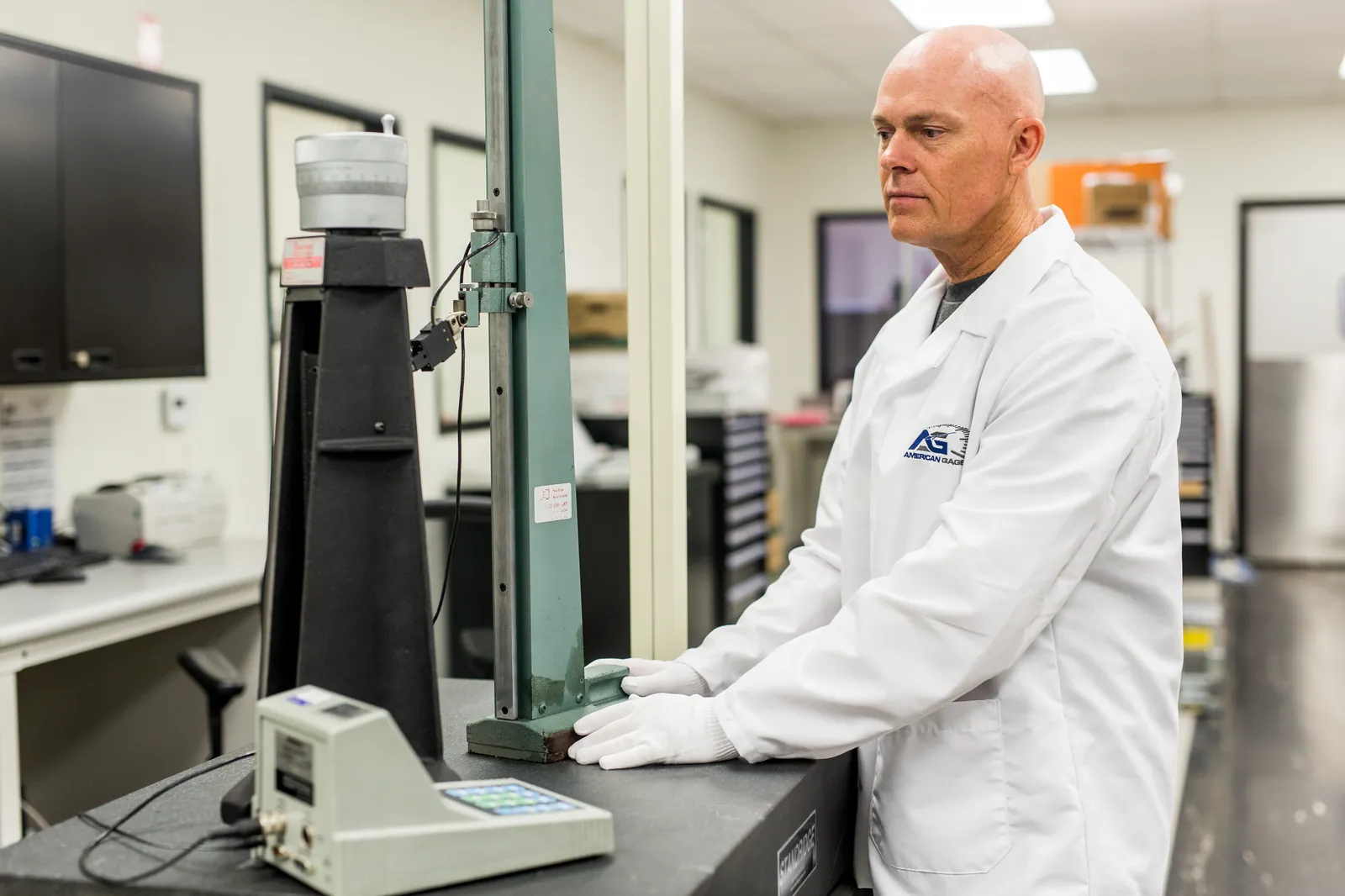
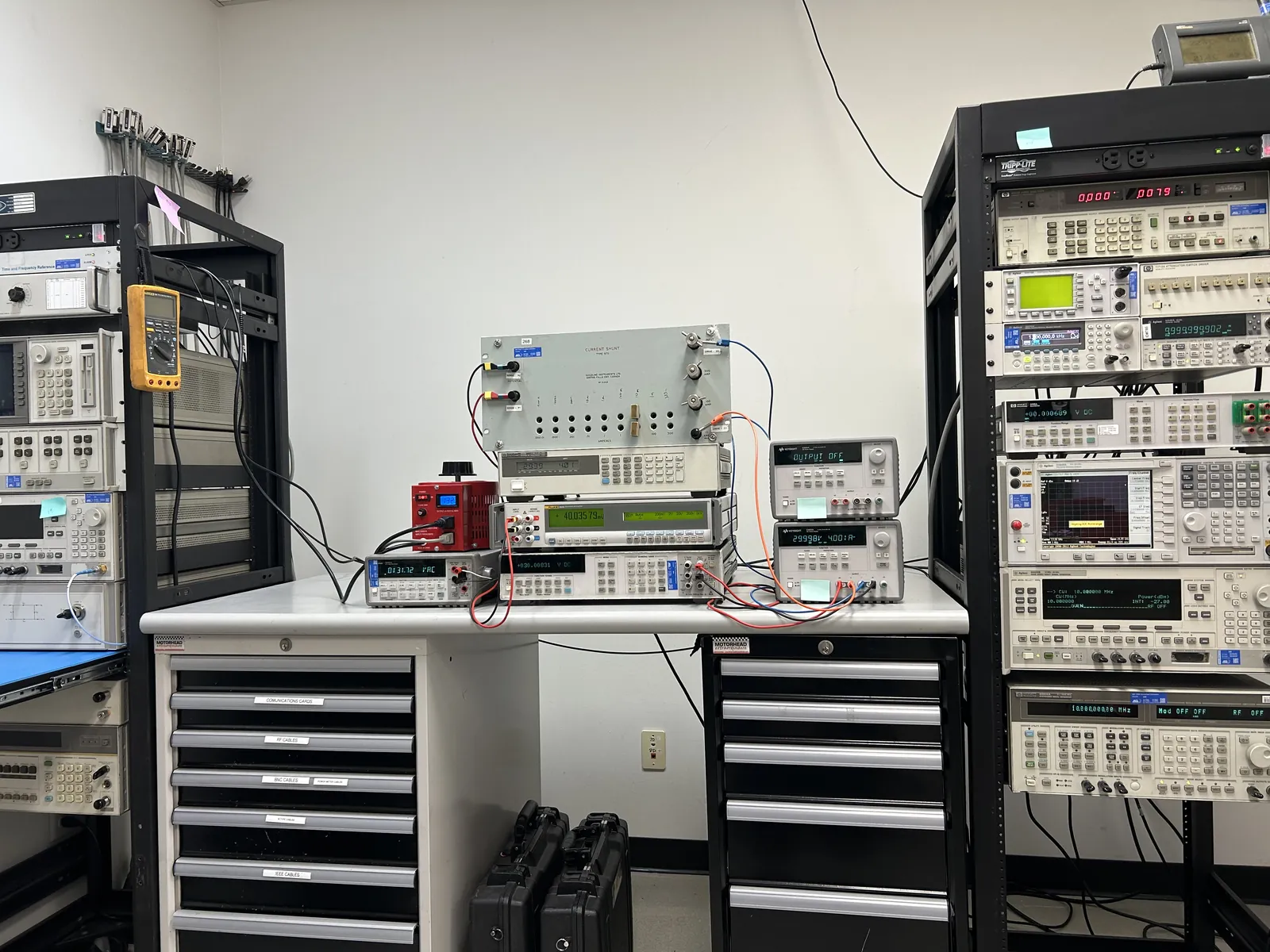
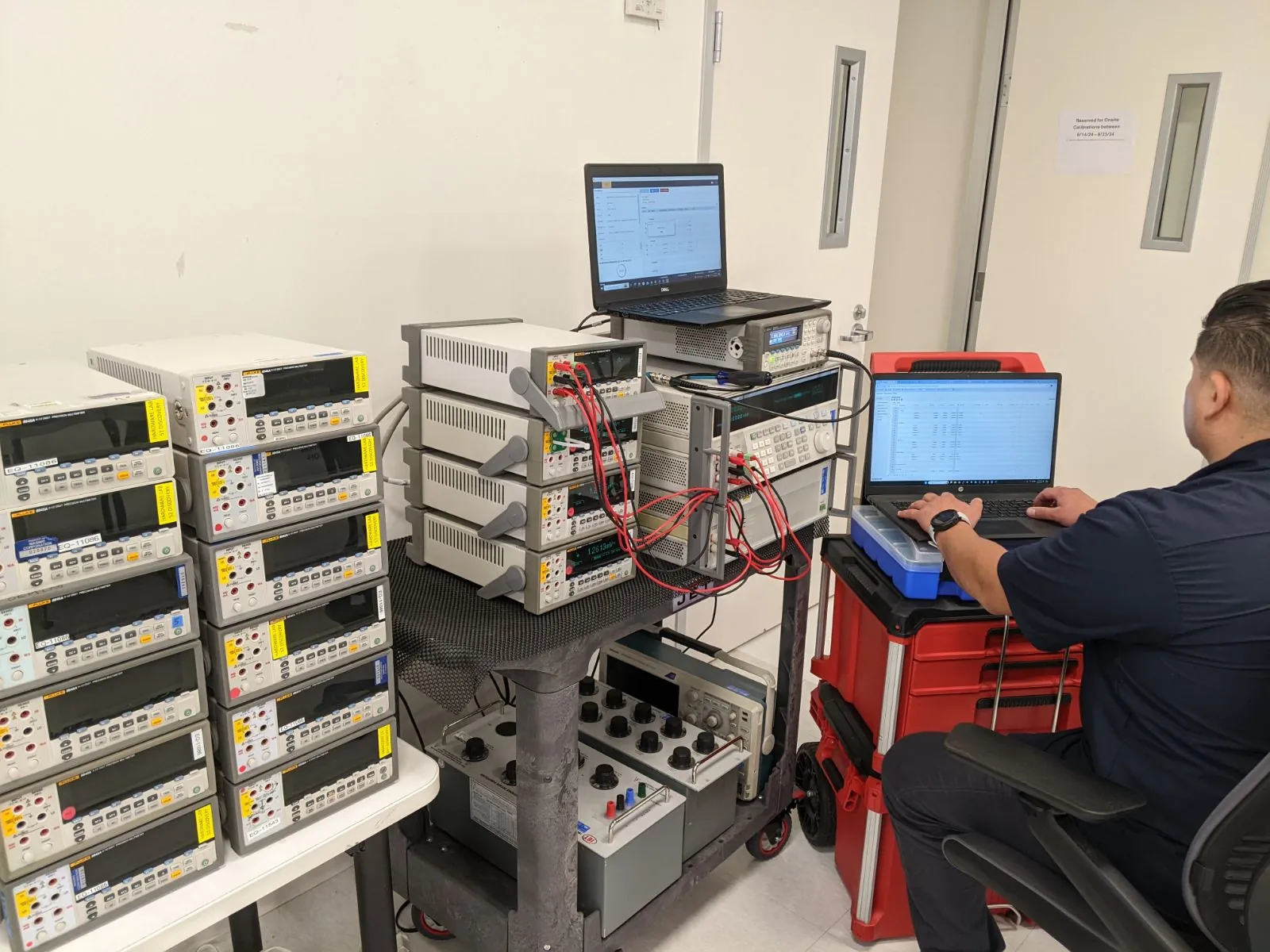
8,000 sq ft of discipline-specific, environmentally controlled laboratories in Placentia — accredited to ISO/IEC 17025:2017 by A2LA, certificate #4296.01. Every instrument you ship is calibrated here and returned to you — never sub-contracted to another lab.
Calibration capabilities available to Folsom companies
Folsom calibration FAQs
Folsom is four hundred miles from your lab. How does this actually work?
By freight, and for Folsom’s instrument mix it works well. Bench RF and electrical instruments, oscilloscopes, power meters, multimeters, pipettes, balances and weights, torque tools, hand gauges, gage blocks, pressure standards and data loggers all ship safely, and we can arrange prepaid inbound shipping so the only thing you handle is packing. Turnaround is quoted door to door including transit, 7 to 10 business days standard with expedited 24, 48 and 72-hour options. Substation and powerplant work, hospital biomedical and imaging equipment, large chambers, platform and tank scales and in-place pressure and flow instruments we schedule on site by arrangement.
Do you calibrate RF and microwave test equipment to space-qualification standards?
Yes. RF power meters and power sensors, vector network analysers, spectrum analysers, signal generators, noise-figure meters, calibration kits and verification standards, waveguide and coaxial standards and attenuation standards, plus connector-mating torque wrenches, which are a controlled parameter in RF assembly. Our certificates carry as-found and as-left data, measurement uncertainty, NIST traceability and the ANSI/NCSL Z540.3 decision rule with TUR, which is what AS9100 calibration-system flowdown and DoD contracts expect to see.
Can you support protection system maintenance and relay testing records?
We calibrate the instruments those records depend on: power and energy reference standards and revenue-meter test sets, CT and PT ratio and polarity sets, relay test sets, insulation resistance and hipot testers, micro-ohmmeters, power-quality analysers, and the pressure, vibration and torque instruments on the hydro-mechanical side. NERC PRC-005 sets the maintenance and testing intervals and requires the documentation; a traceable calibration certificate with uncertainty is what stands behind the test equipment used to produce it.
Is there semiconductor fab metrology work in Folsom?
No, and that is worth being clear about. Intel’s Folsom campus is design, validation, laboratory and data centre work, with emulation equipment used to validate prototype silicon before manufacturing, and Micron’s Folsom site is a silicon design centre. Neither is a wafer fab. What that means practically is that the instrument population is bench and characterisation metrology — high-speed RF and electrical, thermal chamber sensors and mapping, torque drivers, force gauges, vacuum and pressure gauges and mass flow controllers — rather than fab process tooling. Most of it ships.
Popular calibration services
- Pipette Calibration →
- Torque Wrench Calibration →
- Pressure Gauge Calibration →
- Caliper Calibration →
- Micrometer Calibration →
- Gage Block Calibration →
- Spectrum Analyzer Calibration →
- Network Analyzer Calibration →
- Signal Generator Calibration →
- Oscilloscope Calibration →
- On-Site RF Calibration →
- Torque Analyzer Calibration →
- Multimeter Calibration →
- Scale & Balance Calibration →
- Surface Plate Calibration & Resurfacing →
- Thread Gage Calibration →
- Force Gauge Calibration →
- Hardness Tester Calibration & Repair →
- Rush & Expedited Calibration →
- Mitutoyo Instrument Calibration →
- Starrett Instrument Calibration →
- Fluke Instrument Calibration →
Nearby service areas
Need calibration in Folsom?
Send your equipment list and we'll confirm scope, pricing, and turnaround within one to two business days — then ship your instruments to our Placentia lab for accredited calibration and return.