
Service Area · City
Calibration Services in Hawthorne
Six square miles, four FAA-certificated repair stations, a rocket factory, a NASDAQ-listed electronics manufacturer, a lunar rover company and a dense cluster of precision machine shops off 139th Street. Hawthorne has more measurement per acre than almost any city in Los Angeles County, and almost all of it carries a regulator or a prime-contractor flowdown attached.
Distance
≈35 miles from our Placentia lab
Drive time
45–60 minutes
Route days
Tuesday & Thursday — free pickup & delivery
The drive, and the freeway that does not go there
About 35 miles and roughly 45 minutes to an hour, traffic depending — SR-91 west to the I-110 north and the I-105 west, or SR-91 west to the I-405 north. We will not publish a single precise minute figure for an LA-basin run because it would be wrong half the day.
A correction that doubles as proof we know the drive: SR-91 does not enter Hawthorne. Its western terminus is at Vermont Avenue on the eastern edge of Gardena, and the old Artesia Boulevard alignment through Lawndale was relinquished years ago. The 91 is our straight shot out of Placentia; we take it to the 110 or the 405 and drop onto the 105 into the city. Similarly, Hawthorne Boulevard is a city arterial, not State Route 107 — the state route runs only from PCH in Torrance north to the Redondo Beach–Lawndale line and never reaches Hawthorne.
What genuinely serves the city: the I-105 forms its northern boundary with the Metro C Line running in the median, and Crenshaw station on South Crenshaw Boulevard is physically in Hawthorne, within walking distance of the airport. The I-405 forms the western boundary, with access at Rosecrans, El Segundo Boulevard and Inglewood Avenue. 120th Street is the airport and industrial spine. LAX is about five miles away. Hawthorne is on our free Tuesday and Thursday Los Angeles County route.
One Rocket Road, stated accurately
SpaceX’s Hawthorne campus runs to roughly 580,000 square feet, anchored by a three-story former Northrop plant originally built to manufacture 747 fuselage sections. Falcon 9 and Falcon Heavy launch vehicles and Dragon spacecraft are manufactured there, along with much of the company’s in-house engine, stage, spacecraft, avionics and flight-software work, and Falcon mission control operates from the site. The City’s own financial reporting put the campus at more than 6,000 employees, making it Hawthorne’s largest employer, and SpaceX has continued to buy land nearby rather than shrink.
One thing we will state plainly because anyone in the local supply chain knows it: SpaceX’s corporate headquarters moved to Starbase, Texas, in August 2024. The Hawthorne operations did not move. It is the company’s original headquarters and still its Falcon and Dragon manufacturing and engineering centre, and describing it as the headquarters in 2026 is a dated-content tell.
Rocket and spacecraft manufacturing is the densest instrument population we serve. Gage blocks in 00, 0 and AS-1 grades; pin, plug, ring and thread gages; micrometers, calipers, bore gages, height gages and indicators; granite surface plates with flatness and repeat-reading certification; CMM performance artifacts to ISO 10360 and laser-tracker verification artifacts. Torque wrenches, multipliers, transducers and testers; load cells and universal test frames to ASTM E4 with extensometers. Pressure transducers, deadweight testers, digital test gauges, cryogenic pressure instrumentation and vacuum gauges. Thermocouples in K, N and R/S, RTDs and cryogenic sensors for LOX and methane service, dry-block and bath calibrators. Helium mass-spectrometer leak detectors with calibrated leak standards, ultrasonic thickness with step wedges, eddy-current and penetrant reference blocks, radiographic IQIs, hardness testers with certified blocks.
Four Part 145 repair stations inside six square miles
Hawthorne holds four FAA-certificated repair stations: Security Aviation under M and S Air Supply, with airframe, instrument, powerplant and radio ratings; NTAS Maintenance & Engineering, airframe and powerplant; ThinKom Solutions, accessory and radio; and Unilode Aviation Solutions, airframe, for unit load device work. That density is unusual, and it concentrates the single strongest calibration obligation in the regulations.
14 CFR 145.109(b) requires that all inspection and test equipment used to make airworthiness determinations be calibrated to a standard acceptable to the FAA and traceable to NIST, with records. That is a records requirement as much as a technical one, and a certificate that lacks uncertainty, traceability or a stated decision rule does not close it. Our certificates carry all three. The practical population: torque wrenches and testers, micrometers, calipers and dial indicators, bore and thread gages, pitot-static and air-data test sets, nav/comm, transponder and ADS-B test sets, pressure and vacuum gages, leak test sets, megohmmeters and oscilloscopes, and for ULD work, calibrated rules and tapes, flatness and straightness gages, proof-test fixtures, scales and fastener pull testers.
The airport itself changed hands in a way worth knowing about. Archer Aviation acquired the master ground lease from the City of Hawthorne for $126 million in November 2025, taking a 75 percent interest in non-airfield operations through 2055, and now acts as the FBO provider alongside the long-standing Jet Center Los Angeles and Advanced Air hangar and fuel operations. Archer calls Hawthorne the central hub for a planned Los Angeles eVTOL network and uses the field for aircraft testing, with the 2028 Olympics as the target. eVTOL test programs bring high-voltage battery test equipment, hipot and insulation resistance testers, aircraft weight-and-balance scales, jacks and load cells, air-data and transponder sets, cable tensiometers, thermal imagers, vibration analyzers and acoustic instrumentation. Jack Northrop Field also hosts Tesla’s design operation and the Advanced Air scheduled service to Merced, Crescent City and Mammoth Lakes, with county-sealed fuel-farm meters to match.
Satcom antennas, microelectronics and lunar rovers
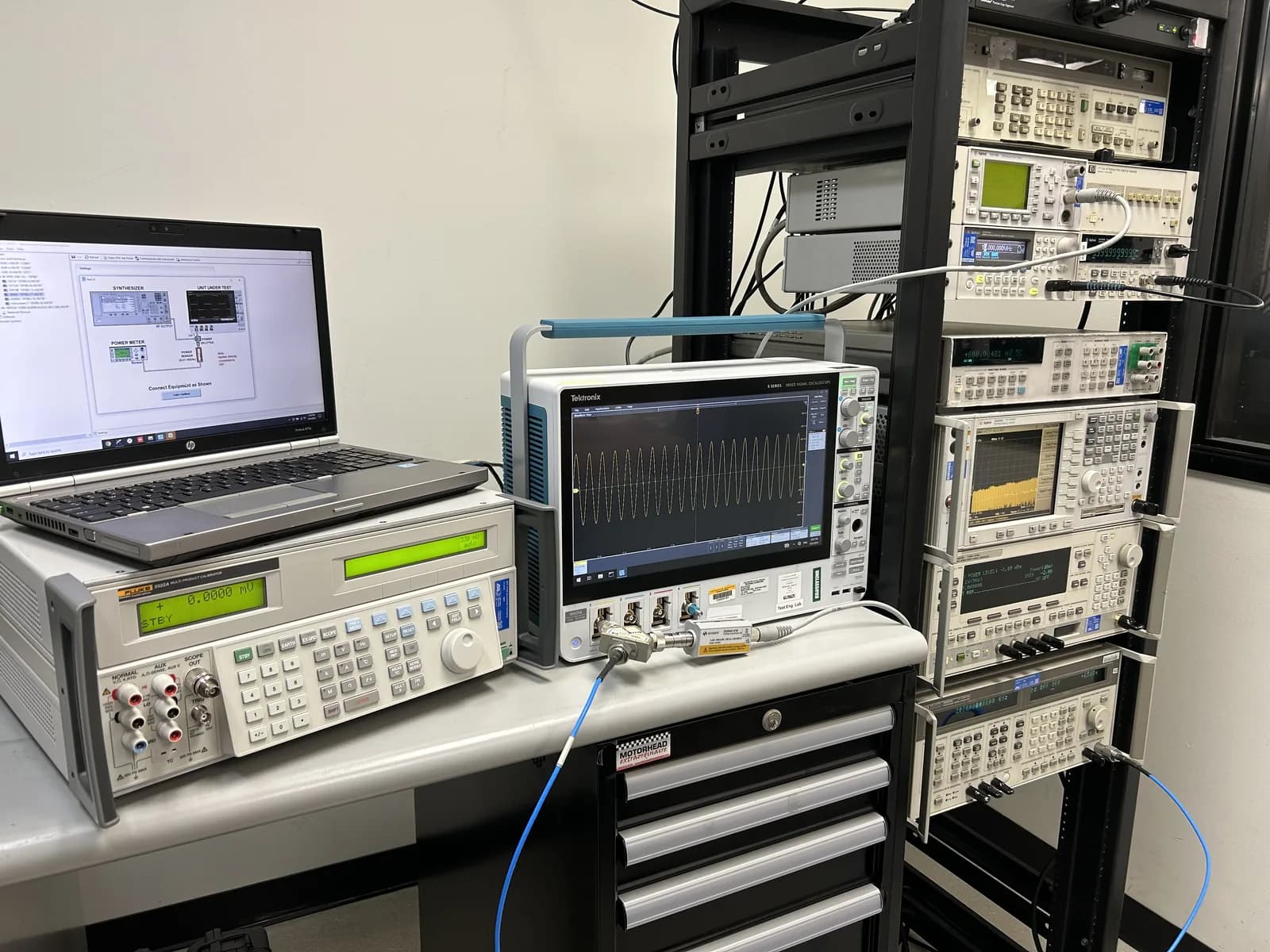
ThinKom Solutions builds low-profile phased-array satcom antennas on West 145th Street using its VICTS technology, for in-flight connectivity, counter-UAS, ground stations and ISR, with terminals committed to or flying on more than 2,500 aircraft. It moved to Hawthorne from Torrance in 2015 and holds a Part 145 certificate — a manufacturer and a repair station in one building. RF metrology is its own world: vector network analyzers, spectrum analyzers, signal generators, power meters and sensors, noise figure instruments, attenuation and gain standards, antenna range and positioner verification, and the torque and alignment tooling for radome and array assembly. We run electrical and RF as a dedicated discipline, not as an add-on.
OSI Systems is headquartered on Chadron Avenue — a NASDAQ-listed company with roughly $1.79 billion in FY2026 revenue across its Rapiscan security screening, Spacelabs patient monitoring and optoelectronics divisions. Next door at 12533 Chadron, OSI Electronics runs more than 60,000 square feet of microelectronics production with two high-performance SMT lines, automated and manual through-hole, and advanced assembly and test, certified AS9100D, NADCAP registered, ITAR controlled and C-TPAT certified.
Electronics manufacturing carries a calibration list most aerospace-focused labs handle badly. Reflow and wave-solder profilers and thermocouples with oven uniformity surveys for J-STD-001 and IPC-A-610 process control. Solder paste inspection and AOI verification. Multimeters, oscilloscopes, power supplies, electronic loads, LCR meters and source meters. ESD compliance measurement under ANSI/ESD S20.20 — surface resistance meters, wrist-strap and footwear testers, ionizer verification. Hipot, insulation resistance, ground-bond and leakage-current testers. Torque screwdrivers for connector and enclosure work. Temperature, humidity and thermal-shock chambers with mapping and data loggers, plus shakers and accelerometers for stress screening. Micro-balances, pull testers and crimp-force monitors. Cleanroom particle counters, differential-pressure gages and airflow hoods. On the medical side of the same portfolio: NIBP and SpO2 simulators, pressure standards, anesthesia and ventilator flow standards, gas analyzers, and electrical safety analyzers to IEC 60601, with ISO 13485 and 21 CFR Part 820 as the Quality Management System Regulation governing the dimensional and CMM work on device-critical features.
The machine shops, and what Hawthorne actually asks of a calibration lab
The precision-machining cluster is the detail that makes this city what it is. Astro Machine Company has been in Hawthorne since 1965, machining prototype and production parts, castings, forgings and assemblies for aerospace, defense and medical customers including Raytheon, Boeing and DRS, and holds an AS/EN/JIS Q 9100 certificate. Warmelin Precision Products, now part of Aerostar Aerospace, runs high-speed five-axis machining of hydraulic, actuation and structural components. Around them sits a tight geographic cluster along West 139th Street, Daphne and Cordary Avenues and Crenshaw Boulevard. Venturi Astrolab, also Hawthorne-based, builds the FLEX planetary rover and won a NASA lunar terrain vehicle award in May 2026 — and has been hiring a CNC machine shop manager, which tells you the precision work is in house.
Shop metrology is our founding discipline. Calipers and micrometers of every type, bore, depth and height gages, dial and test indicators. Pin, plug, ring, thread and taper gages, master and setting rings, gage blocks, angle blocks, sine bars and plates. Surface plates, squares, straight edges, V-blocks and parallels. Optical comparators, profile projectors, toolmaker’s microscopes and vision systems. Hardness testers with certified blocks, surface-roughness testers and specimens, roundness and form testers. Torque tools and force gages. Machine-tool geometry verification with ballbar, laser interferometer and electronic levels. Coating and plating thickness gauges. And thermocouples and furnace temperature uniformity surveys wherever heat treat runs in house or at the South Bay houses the Hawthorne shops subcontract to — which is where AMS 2750 pyrometry bites hardest.
What Hawthorne asks of a calibration lab, in the end, is documentation discipline. NASA and DoD flowdowns bring ANSI/NCSL Z540.3 with its two percent false-accept risk requirement and TUR documentation; AS9100 and AS9102 first article bring monitoring and measuring resource control; Nadcap brings special-process scrutiny; ITAR and EAR make a US lab with US technicians the simpler answer; Cal/OSHA and South Coast AQMD generate their own measurement obligations around pressure vessels, crane load tests, ventilation, noise and coating and plating operations. Every certificate we issue states as-found and as-left values, measurement uncertainty, NIST traceability and the Z540.3 decision rule with TUR, under ISO/IEC 17025:2017 accreditation from A2LA, certificate 4296.01. Hawthorne is 35 miles away on our free Tuesday and Thursday route, expedited service runs at 24, 48 and 72 hours, and on-site calibration covers what should not leave the building. American Gage has done this from inside Orange County since 1968, more than a million calibrations deep.
Industries we serve in Hawthorne
- Space Launch & Spacecraft
- Aviation MRO & Part 145
- Precision Machining
- Electronics & Microelectronics
- Medical Devices
The Lab Behind the Routes
Where Hawthorne instruments actually get calibrated.
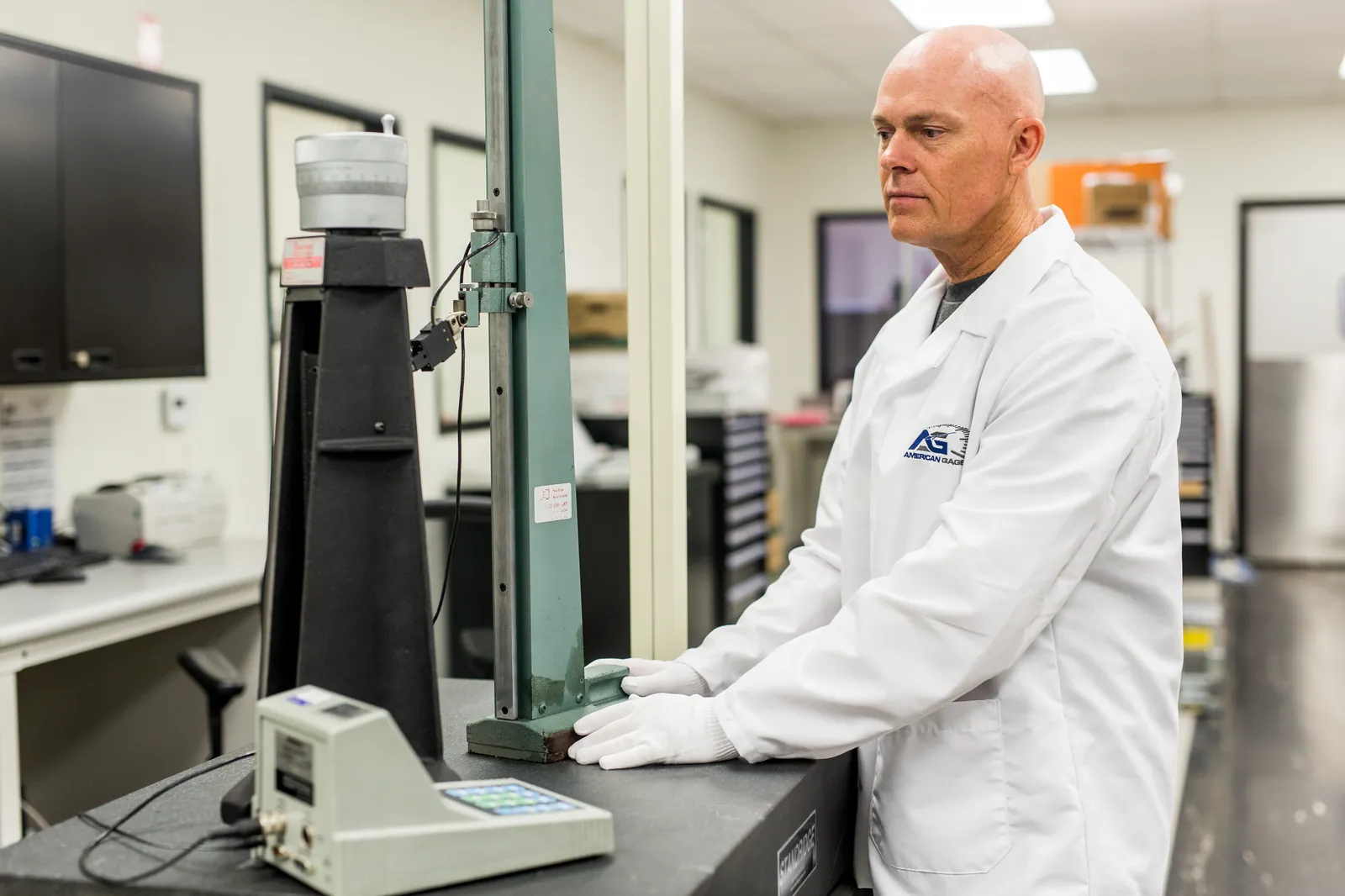
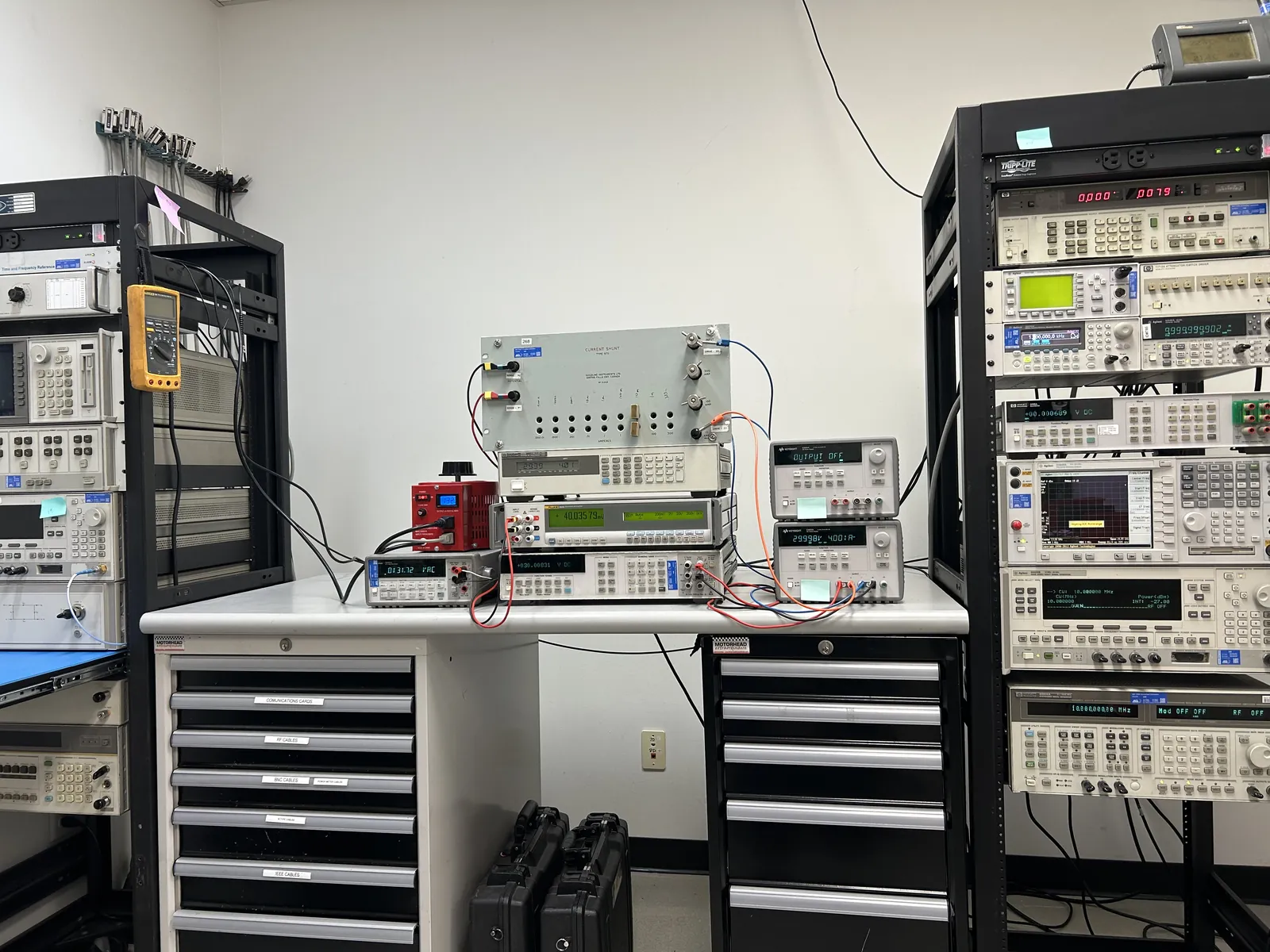
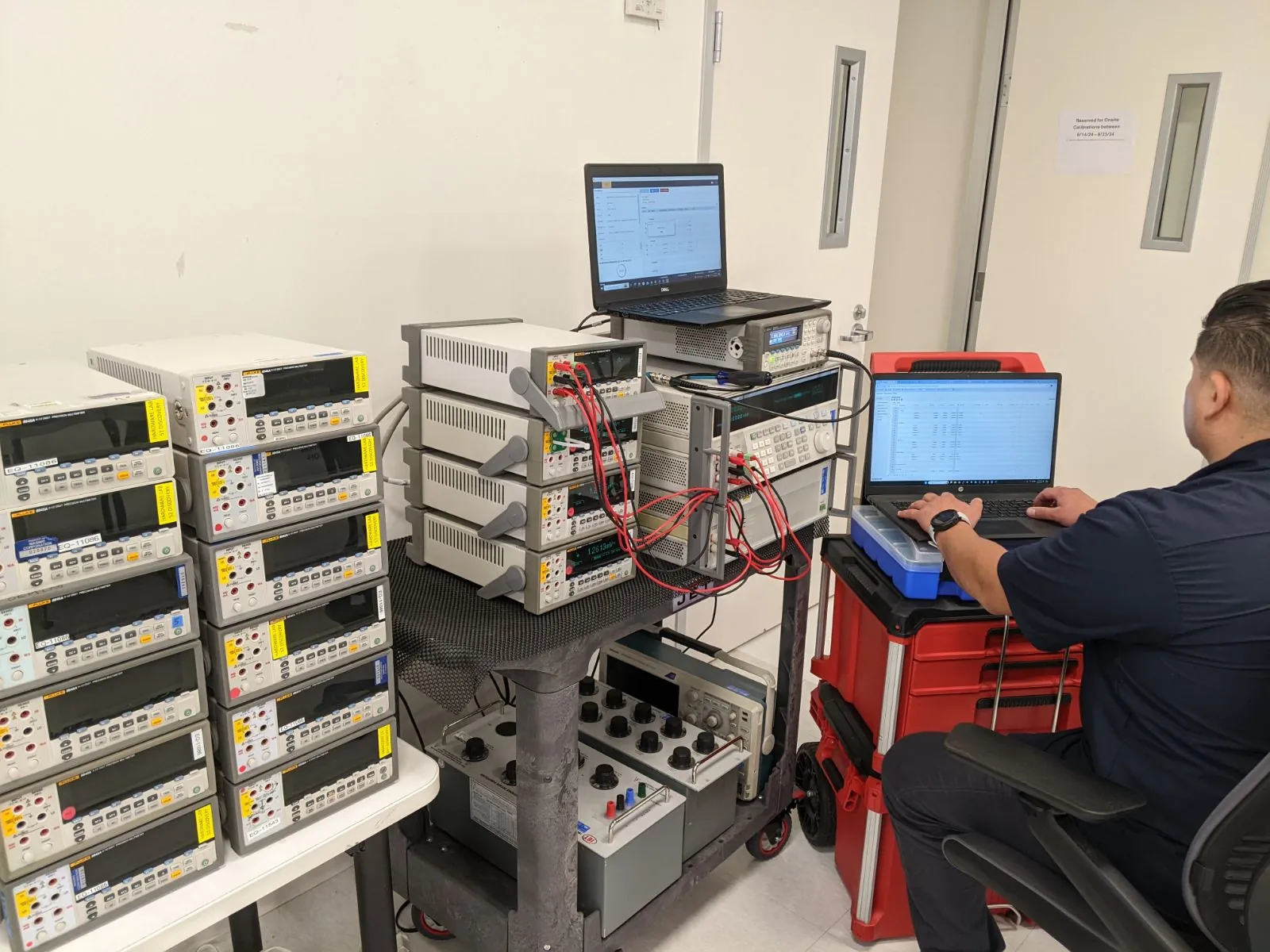
8,000 sq ft of discipline-specific, environmentally controlled laboratories in Placentia — accredited to ISO/IEC 17025:2017 by A2LA, certificate #4296.01. Nothing is forwarded to out-of-state labs.
Calibration capabilities available to Hawthorne companies
Hawthorne calibration FAQs
How far is your lab from Hawthorne?
About 35 miles, and realistically 45 minutes to an hour depending on the basin — SR-91 west to the I-110 and I-105, or SR-91 west to the I-405. Hawthorne is on our free Tuesday and Thursday Los Angeles County pickup route.
Do your certificates meet 14 CFR 145.109(b)?
Yes. That rule requires inspection and test equipment used for airworthiness determinations to be calibrated against a standard acceptable to the FAA and traceable to NIST, with records. Our certificates document traceability, measurement uncertainty, as-found and as-left values and the decision rule applied.
Can you calibrate RF and microwave test equipment?
Electrical and RF is one of our nine in-house disciplines — vector network analyzers, spectrum analyzers, signal generators, power meters and sensors, attenuation and gain standards, oscilloscopes, LCR meters, hipot and insulation testers.
Do you support Z540.3 and NASA or DoD supplier flowdowns?
We do. Certificates state the ANSI/NCSL Z540.3 decision rule with test uncertainty ratio, measurement uncertainty and NIST traceability, under ISO/IEC 17025:2017 accreditation from A2LA, certificate 4296.01 — which is what prime-contractor and NASA flowdowns are asking you to produce.
Popular calibration services
- Pipette Calibration →
- Torque Wrench Calibration →
- Pressure Gauge Calibration →
- Caliper Calibration →
- Micrometer Calibration →
- Gage Block Calibration →
- Spectrum Analyzer Calibration →
- Network Analyzer Calibration →
- Signal Generator Calibration →
- Oscilloscope Calibration →
- On-Site RF Calibration →
- Torque Analyzer Calibration →
- Multimeter Calibration →
- Scale & Balance Calibration →
- Surface Plate Calibration & Resurfacing →
- Thread Gage Calibration →
- Force Gauge Calibration →
- Hardness Tester Calibration & Repair →
- Rush & Expedited Calibration →
- Mitutoyo Instrument Calibration →
- Starrett Instrument Calibration →
- Fluke Instrument Calibration →
Nearby service areas
Need calibration in Hawthorne?
Send your equipment list and we'll confirm scope, pricing, and turnaround within one to two business days — with free pickup on the Tuesday & Thursday route.