
Service Area · City
Calibration Services in Grass Valley
Grass Valley is a town of about 14,000 people at 2,400 feet in the Sierra foothills whose name ended up printed on broadcast equipment all over the world. The company that put it there has moved on, but the electronics and machine-building firms that grew up around it are still on Litton Drive, Charles Drive and Nevada City Avenue, and they still need traceable calibration. We are roughly 470 road miles south of them, so this is a ship-in account with on-site visits by arrangement, and we would rather say that plainly than pretend to a route we do not run.
Service model
Ship-in service, or on-site calibration by appointment
Inbound shipping
Outside our free pickup routes, roughly 470 road miles south of us
Turnaround
7 to 10 business days standard, expedited available
One freeway, and the nearest interstate is in another county
The City of Grass Valley puts it bluntly in its own General Plan: the only freeway in the city is State Route 49. SR-20 and SR-49 run concurrently for about five miles between Nevada City and Empire Street in Grass Valley as a four-lane limited access highway carrying 30,000 to 37,000 vehicles a day, past interchanges at Brunswick Road and Main Street, Dorsey Drive, East Main Street, Bennett and Bank Streets, and finally Empire Street, where the two routes split. From there SR-20 turns west as a two-lane arterial toward Penn Valley and Marysville, and SR-49 continues about twenty-three miles south to Auburn.
There is no interstate near the town. The nearest I-80 access is Colfax, about thirteen miles south along Colfax Avenue and the SR-174 corridor, or Auburn about twenty-three miles south on SR-49, and both of those interchanges are in Placer County rather than Nevada County. That is a geography worth stating accurately because it is the whole reason the service model here is what it is: Nevada City, not Grass Valley, is the county seat, Grass Valley is the larger of the two, and everything industrial reaches the rest of California through two state routes.
Inside the city the roads that carry freight are South Auburn Street, Empire Street, Mill Street, Neal Street, Main Street, Nevada City Highway and Brunswick Road, with Idaho-Maryland Road, Dorsey Drive, Sutton Way and Whispering Pines Lane feeding them as collectors. Several segments of Brunswick Road already run at the bottom of the service-level scale. Freight is also the point: a 470-mile haul is a two-day round trip by road, which is why instruments from Grass Valley come to us by carrier instead.
The name on the broadcast gear, and what is actually still here
Grass Valley Group was founded in Nevada County in 1959 by Dr. Donald Hare and at its peak employed around 1,500 county residents. That is history now. The company is headquartered in Montreal under Black Dragon Capital, which acquired it from Belden in July 2020, manufacturing was consolidated away from here, and the former Crown Point campus was sold to the non-profit InConcert Sierra in March 2023. Anyone writing that Grass Valley still runs a factory in Grass Valley is working from a decade-old press kit.
What the industry left behind is a genuine cluster. AJA Video Systems is at 180 Litton Drive and Litton Engineering Laboratories at 200 Litton Drive, two doors apart on the same short street. The Nevada County Economic Resource Council also points to electronics design and hardware firms in the western county, and the Whispering Pines Business Park at Whispering Pines Lane and Brunswick Road, along with the Crown Point Circle buildings, is where that light-industrial space actually sits.
For a video and electronics hardware operation the instrument population is bench metrology. Digital multimeters, oscilloscopes, waveform and video pattern generators, DC power supplies and electronic loads, LCR meters, function generators, frequency counters, clamp meters and insulation resistance testers, with spectrum analyzers, vector network analyzers, signal generators and power meters where the work goes up in frequency. All of it is calibrated in our electrical and RF laboratory, and almost all of it ships safely in a case.
Heating elements, controllers, and roadside weather sensors
Benchmark Thermal operates an office and manufacturing facility at 13185 Nevada City Avenue, building electrical heating elements and controls for industry: cartridge heaters, drum heaters, enclosure heaters, semiconductor heaters and plug-and-play temperature controllers. That is the most calibration-dependent manufacturing in town, because you cannot build or verify a heater and its controller without reference temperature instrumentation that somebody else has certified.
In practice that means type J, K, T and E thermocouples, thermocouple simulators and calibrators, RTDs and PT100s, dry-block and bath comparators, handheld and infrared thermometers, thermal data loggers and chart recorders, and the mapping of burn-in and environmental chambers. Our temperature and humidity laboratory works against triple point of water cells and fixed-point standards, and certificates carry as-found and as-left readings at each test point rather than a bare pass.
The same discipline reaches the environmental monitoring side of the local economy. High Sierra Electronics, now a brand of AEM, works from Grass Valley offices on hydrometeorological flood warning, high water detection, dam and levee monitoring and Road Weather Information Systems, both fixed and vehicle-mounted. Sensors like those are only as trustworthy as the temperature, humidity and dew point references they were checked against, and the pressure and level instrumentation alongside them runs through our pressure laboratory on test gauges and transducers.
Machine tools, cutting systems and the dimensional work behind them
Litton Engineering Laboratories builds glassworking lathes and rebuilds and remanufactures them, with thousands of its machines in service worldwide, and sells replacement parts for them. Autometrix Precision Cutting Systems, at 12098 Charles Drive, builds CNC single-ply and low-ply knife cutting systems and the pattern design software that drives them. Two machine builders in a town this size is unusual, and machine building is the most gauge-intensive work there is.
A shop like that keeps micrometers and calipers, bore and depth gauges, height gauges, gage blocks, pin and plug gauges, thread ring and plug gauges, dial and test indicators, squares and straight edges, and granite surface plates that everything else is set up against. Assembly adds torque, and torque wrench and torque screwdriver calibration is the single highest-volume item through our force and torque laboratory, along with torque testers, transducers, load cells and force gauges.
It is worth being straight about what Grass Valley is not. There is no aerospace prime here, no NADCAP special-process cluster, no medical device manufacturer, no automotive tier supply base and no FAA repair station, and the city itself describes an economy weighted toward tourism and services. Nevada County Airport is a county-owned general aviation field about three miles east of town, and the Idaho-Maryland Mine that gave Idaho-Maryland Road its name is not a permitted operation: the use permit was denied and the vested-rights claim failed in court in May 2026.
The hospital lab, the irrigation district, and how ship-in actually works
Sierra Nevada Memorial Hospital, part of the Dignity Health network, sits at 155 Glasson Way and is one of the county’s largest employers. Its clinical laboratory operates under CLIA, and a CLIA lab is a steady, unglamorous calibration account: single-channel and multichannel air-displacement pipettes, repeaters and dispensers, analytical and precision balances and weight sets, centrifuge checks, and the refrigerator, freezer and incubator temperature monitoring that inspections look at first. Pipette work runs gravimetrically in our pipette laboratory.
The Nevada Irrigation District is the other public-sector anchor, and a water and sewage utility runs on instrumentation: flow meters and mass flow devices, level and pressure transmitters, bench scales and laboratory balances, and water-quality meters that have to be defensible when a reading is questioned. Sierra College keeps its Nevada County campus in Grass Valley, which is where a good share of the local technician workforce comes from.
Here is the mechanics of a ship-in account. Bench electrical and RF instruments, oscilloscopes and power meters, thermocouples and loggers, pipettes, balances and weight sets, torque tools, hand gauges, gage blocks and pressure standards all travel well, and we can arrange prepaid inbound freight so the only thing you handle is packing. Turnaround is quoted door to door including transit, 7 to 10 business days standard with 24, 48 and 72-hour expedited service available. Granite surface plates measured in place, large environmental chambers, platform and tank scales, in-place flow and pressure loops and hospital biomedical equipment we schedule on site instead. If you are working out which instruments should ship and which should not, send us the list.
Industries we serve in Grass Valley
- Broadcast & Video Electronics
- Machine Tool & Equipment Manufacturing
- Industrial Heating & Temperature Controls
- Hospitals & Clinical Labs (CLIA)
- Water & Public Utility Instrumentation
The Lab Behind the Routes
Where Grass Valley instruments actually get calibrated.
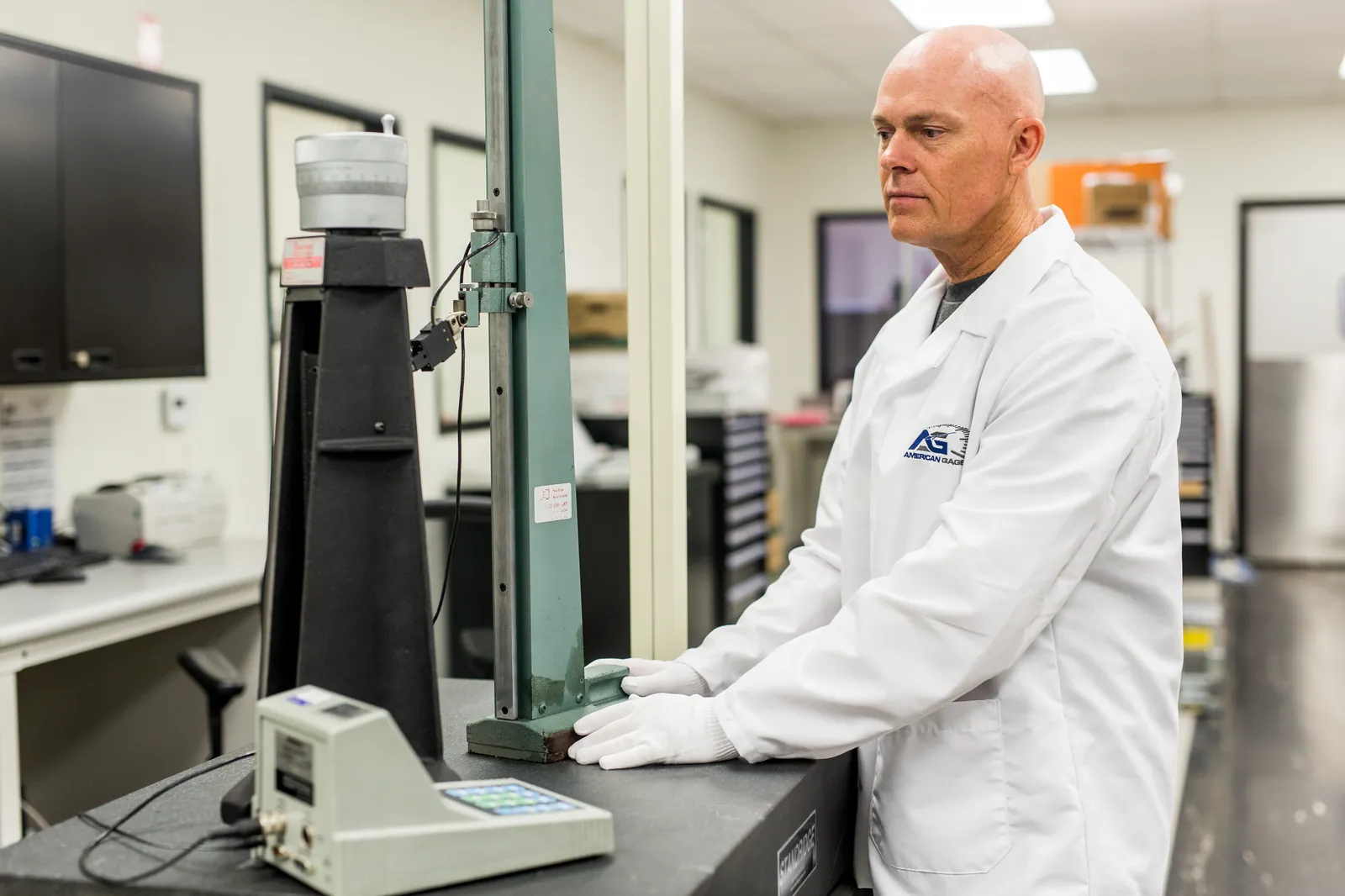
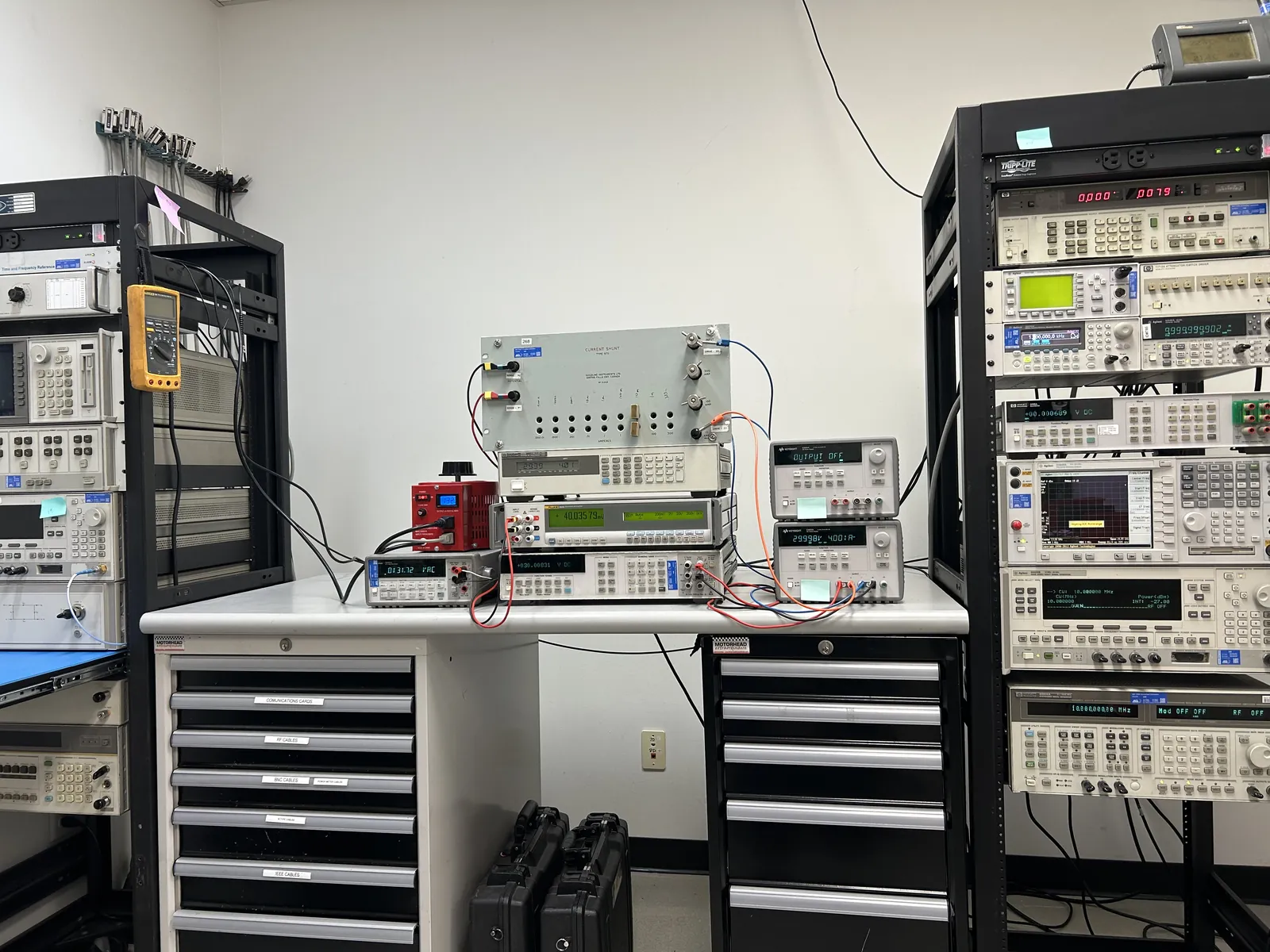
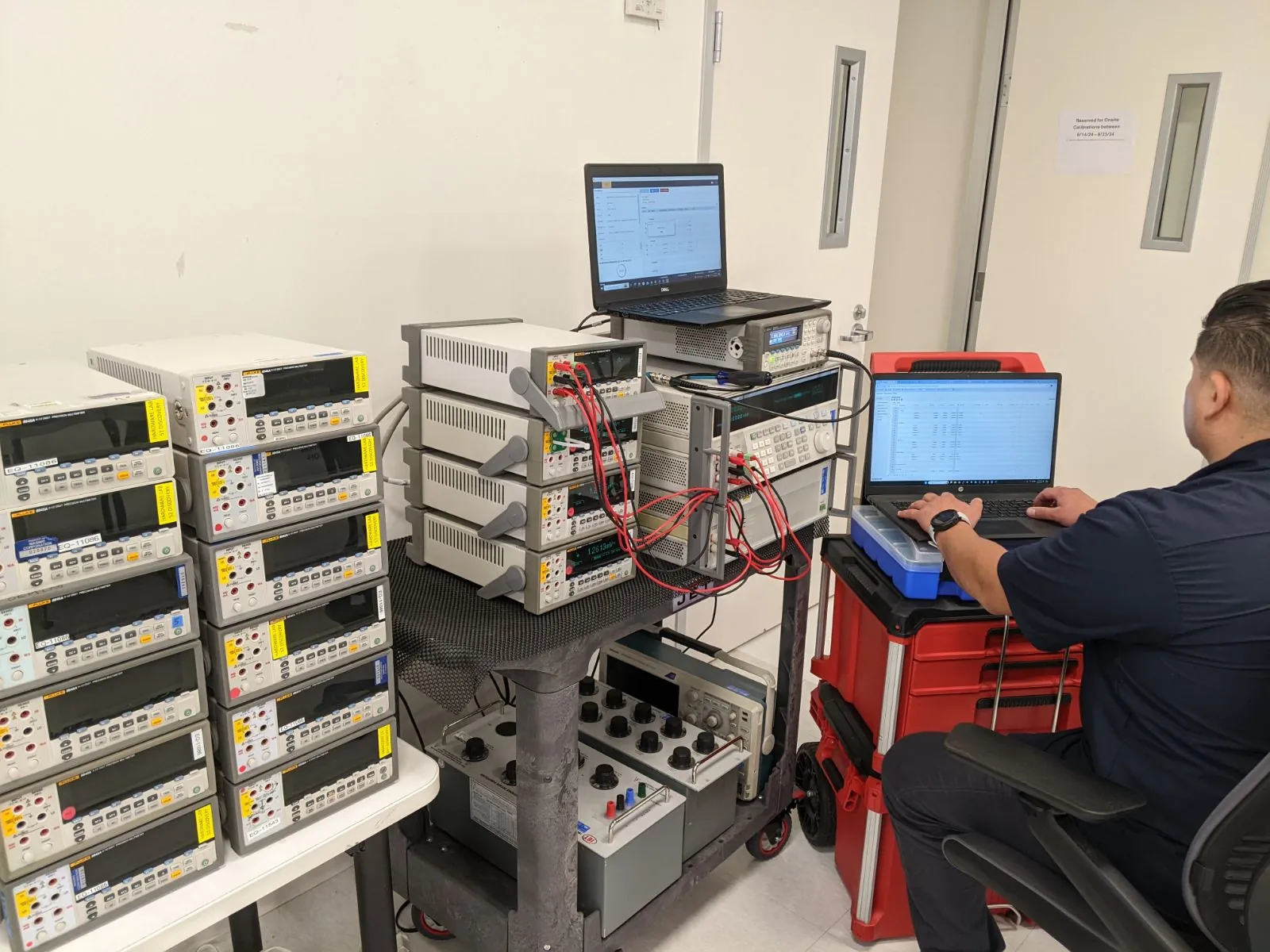
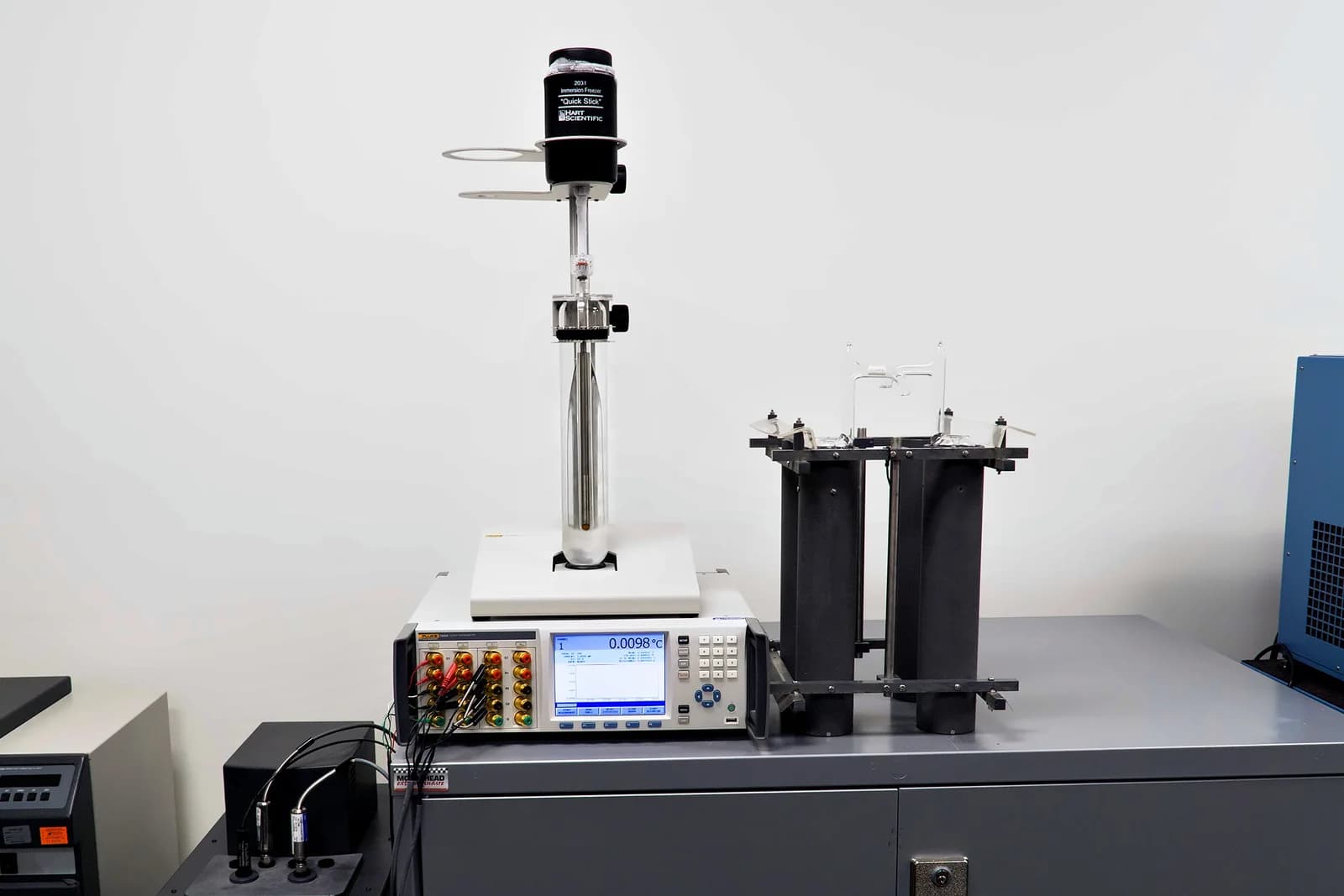
8,000 sq ft of discipline-specific, environmentally controlled laboratories in Placentia — accredited to ISO/IEC 17025:2017 by A2LA, certificate #4296.01. Every instrument you ship is calibrated here and returned to you — never sub-contracted to another lab.
Calibration capabilities available to Grass Valley companies
Grass Valley calibration FAQs
Grass Valley is hundreds of miles from your lab. Why would we ship instruments to you?
Because for most of a Grass Valley instrument list the distance makes no practical difference. We are roughly 470 road miles south, in Placentia, and bench electrical and RF instruments, thermocouples and data loggers, pipettes, balances and weight sets, torque tools, hand gauges, gage blocks and pressure standards all ship safely. We can arrange prepaid inbound freight, and turnaround is quoted door to door including transit, 7 to 10 business days standard with 24, 48 and 72-hour expedited options. What you get back is an A2LA ISO/IEC 17025:2017 certificate with as-found and as-left data, uncertainty and NIST traceability.
Do you run a pickup route to Nevada County?
No, and we will not claim one. Our free pickup and delivery routes cover Orange County on Mondays and Wednesdays, Los Angeles County on Tuesdays and Thursdays, and the Inland Empire on Fridays. Grass Valley is far outside that footprint, so service here is inbound freight with on-site calibration by appointment when the instruments genuinely cannot travel. Scheduling a single on-site visit that covers a year of in-place work is usually the efficient way to handle that part of the list.
What would you calibrate for a heating element and temperature controller manufacturer?
The reference instrumentation the product is verified against. Type J, K, T and E thermocouples and thermocouple simulators and calibrators, RTDs and PT100 probes, dry-block and bath comparators, handheld and infrared thermometers, thermal data loggers and chart recorders, and burn-in and environmental chamber mapping. Our temperature and humidity laboratory works against triple point of water cells and fixed-point standards, and every certificate reports as-found and as-left values at each test point so you can see drift between cycles rather than just a pass or fail.
Which instruments should not be shipped?
Anything whose calibration depends on where it sits or how big it is. Granite surface plates are measured in place, because moving one invalidates the result. Large environmental and burn-in chambers are mapped in situ. Platform and tank scales, in-place flow and pressure loops, substation and utility instrumentation, and hospital biomedical and imaging equipment are all on-site work. Everything else on a typical Grass Valley list travels, and we are happy to split an inventory into ship-in and on-site before you commit to anything.
Popular calibration services
- Pipette Calibration →
- Torque Wrench Calibration →
- Pressure Gauge Calibration →
- Caliper Calibration →
- Micrometer Calibration →
- Gage Block Calibration →
- Spectrum Analyzer Calibration →
- Network Analyzer Calibration →
- Signal Generator Calibration →
- Oscilloscope Calibration →
- On-Site RF Calibration →
- Torque Analyzer Calibration →
- Multimeter Calibration →
- Scale & Balance Calibration →
- Surface Plate Calibration & Resurfacing →
- Thread Gage Calibration →
- Force Gauge Calibration →
- Hardness Tester Calibration & Repair →
- Rush & Expedited Calibration →
- Mitutoyo Instrument Calibration →
- Starrett Instrument Calibration →
- Fluke Instrument Calibration →
Nearby service areas
Need calibration in Grass Valley?
Send your equipment list and we'll confirm scope, pricing, and turnaround within one to two business days — then ship your instruments to our Placentia lab for accredited calibration and return.