Service Area · City
Calibration Services in Huntington Park
Huntington Park is three square miles, incorporated in 1906 as a streetcar suburb for industrial workers, ringed by five freeways and entered by none of them. It is a city of small job shops in old buildings on small parcels — and two of its most serious operations are Nadcap-accredited aerospace process suppliers: a commercial heat treater and an NDT and chemical-processing house. This is not an aerospace assembly town. It is an aerospace process town, and process work is governed by pyrometry and calibrated test instrumentation.
Distance
≈26 miles from our Placentia lab
Drive time
35–45 minutes
Route days
Tuesday & Thursday — free pickup & delivery
Surrounded by freeways, served by none
The City's own housing element puts it plainly: Huntington Park is surrounded by major highways, with the 5 and the 10 to the north, the 710 to the east, the 105 to the south and the 110 to the west. Surrounded, not served. No freeway passes through the city, which is three square miles, roughly six miles south of downtown Los Angeles, about fifteen miles northeast of LAX, and nearly built out with very little vacant land left. The practical consequence is that the last mile or two into any address here is always on an arterial — Slauson Avenue, Florence Avenue, Pacific Boulevard, Santa Fe Avenue or Long Beach Boulevard.
That makes the mis-attributions worth naming. The 710 does not pass through Huntington Park: its exit sequence runs Long Beach, Compton, Paramount, Lynwood, South Gate, Bell, then across the Bell–Vernon line at Atlantic Boulevard and on to Commerce. It runs about a mile to a mile and a half east, through Bell and Vernon. The 110 is roughly two miles west and does not enter the city. The 91 is nowhere close — its western terminus is Vermont Avenue at the Gardena city limits, six or seven miles south-southwest.
Florence Avenue is sometimes called State Route 42, which is wrong twice over. SR-42 does not exist — it was designated in 1964, its legislative routing was reassigned to the Century Freeway in 1968, and Caltrans relinquished the remaining surface portions in 2000. And SR-42 was never Florence Avenue in the first place: it followed Manchester and Firestone Boulevards, two miles south. Leftover shields survive elsewhere in the county, which is how the error propagates. Call it Florence Avenue. The real industrial streets here are Slauson Avenue, Alameda Street along the western edge, Pacific Boulevard, Randolph Street, Gage Avenue, Maywood Avenue, Bickett Street and Benedict Way.
Bodycote on Benedict Way, and why pyrometry is the whole job
Bodycote's Huntington Park plant at 3370 Benedict Way is commercial heat treatment: nitriding, carburising, vacuum and oil quenching, annealing, homogenising and cryogenic treatment, plus blasting, cleaning, degreasing and straightening. Bodycote's own site lists the accreditations — AS/EN 9100, ISO 9001, Nadcap for heat treating and Nadcap for its laboratory. For a calibration lab, this is the single most defensible and most demanding account in the city, because commercial heat treating is governed by aerospace pyrometry specification, and pyrometry is a calibration specification before it is anything else.
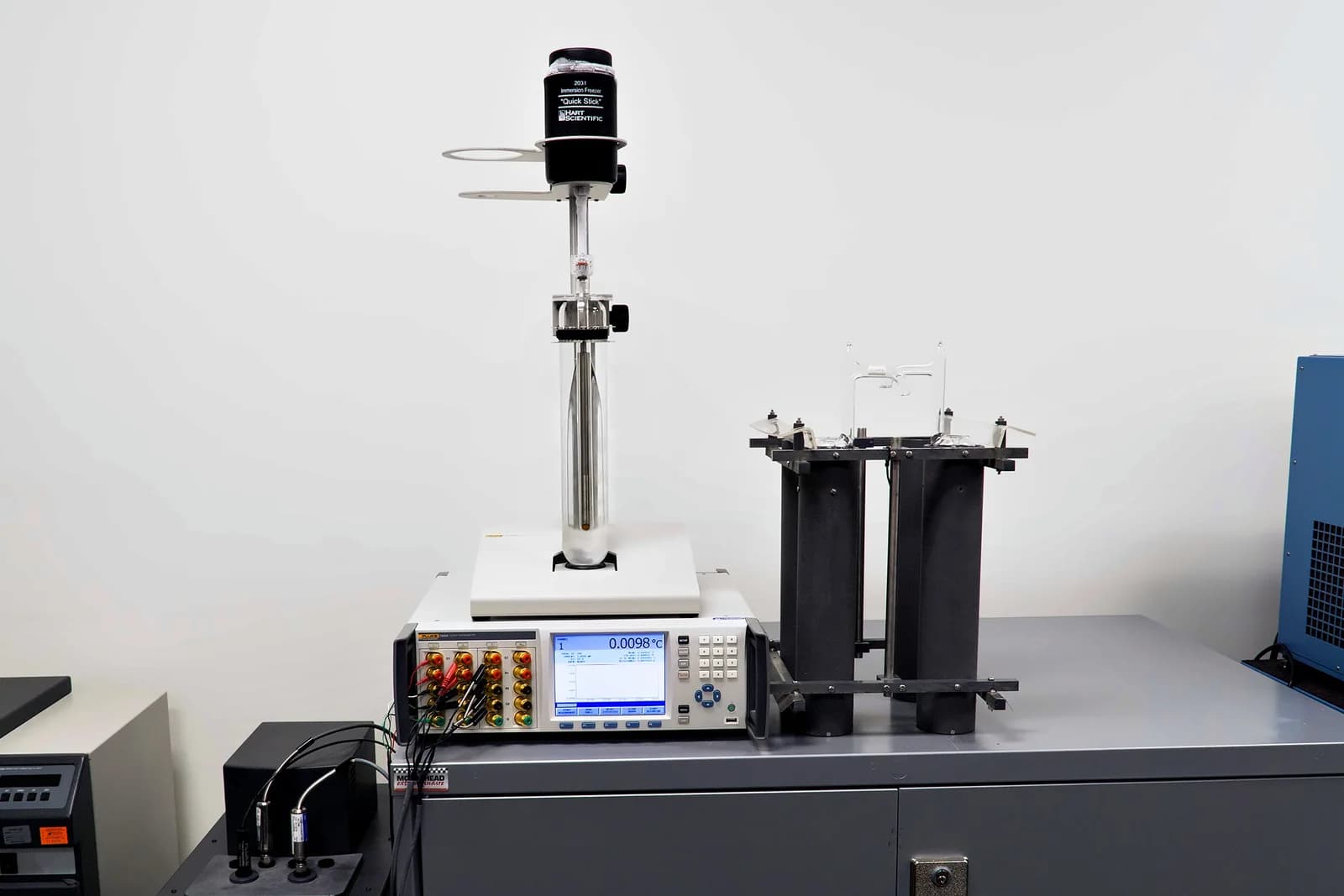
What that means concretely: load and control thermocouples across several types, system accuracy test instruments, temperature uniformity survey field instrumentation, furnace controllers, recorders and over-temperature protection — with prescribed calibration intervals and accuracy classes for every one of them, plus cryogenic temperature measurement for the cryo line. Our temperature and humidity laboratory exists for exactly this work, and the traceability chain behind it runs to fixed-point cells rather than to a comparison bath and a hope.
Around the furnaces sits the rest of the plant. Vacuum gauges and transducers on the vacuum furnaces, quench-gas pressure transducers and transmitters, oil-quench and compressed-air pressure gauges. Nitrogen, argon, hydrogen, nitriding ammonia and carrier gas mean mass flow controllers, rotameters and flow meters plus dew-point and carbon-potential probes. Multimeters and multifunction calibrators for control-loop and thermocouple-input verification. Calipers and micrometers with case-depth measurement, distortion and straightness checks after quench, and hardness reference blocks. On the accredited laboratory side, hardness tester load verification across Rockwell, Brinell and Vickers. Charge-weighing balances and floor scales, and accelerometers on quench pumps, blowers and vacuum pumps. Under AS9100 and Nadcap audit, every one of those calibrations has to be documented with uncertainty and traceability — which is what our certificates state.
Aircraft X-Ray Laboratories on Pacific Boulevard
Aircraft X-Ray Laboratories at 5216 Pacific Blvd runs three lines of business, and all three are instrument-dependent. Non-destructive testing: computed radiography, digital and conventional film X-ray, penetrant inspection, magnetic particle inspection, hardness and conductivity testing. Chemical processing: chromic, sulfuric and boric-sulfuric acid anodize, passivation, chemical film, and cleaning and etching of aluminium and titanium. And paint: robotic and standard primer and topcoat, fuel tank coating, dry and solid film lubricant, and bead and aluminium oxide blasting. Their own site states the services are fully Nadcap certified. They do not claim AS9100, A2LA or ISO/IEC 17025 on their site, so we do not attribute those to them. It is also a nice, true detail about how tightly mixed this city is that an aerospace process house has a Pacific Boulevard address on the city's historic retail street.
NDT has a calibration list most people never think about. X-ray tube voltage and current verification, film and digital densitometers, image-quality indicators and step wedges, eddy-current conductivity meters against reference standards, rectifier and power supply verification on the anodize line, and — the ones the standards name explicitly — ultraviolet radiometers and visible-light meters for the fluorescent penetrant and magnetic particle booths, plus magnetic field meters and field indicators. The penetrant and magnetic particle standards require those to be verified, and so do the radiography and personnel-qualification documents the industry works to.
The chemical processing side adds its own. Anodize and passivation tank RTDs and thermocouples, paint and dry-film-lube bake oven thermocouples with uniformity surveys, penetrant dryer and developer ovens, and data loggers. Spray-gun and blast-cabinet air pressure gauges, regulators and transmitters. Analytical and bench balances with test weights for bath make-up. Pipettes for bath titration — free acid, dissolved aluminium, chromate concentration, etch rate — which is a real and routinely overlooked calibration need on an anodize line. Coating thickness gages, hardness testers, surface plates, gage blocks and pin gages on the dimensional side. And scrubber and ventilation flow measurement, which is not optional: the facility appears by name and address on the regional air district's chromium anodizing and electroplating facility list, and the hexavalent chromium rule governing those operations has been under active amendment, with a federal air-toxics standard behind it. This is an air-quality priority community, and the measurements that demonstrate compliance have to be traceable.
Crown Poly on Bickett Street, and the rail corridor on Alameda
Crown Poly at 5700 Bickett St runs blown-film extrusion and bag converting, and states on its own site that all of its products are manufactured in Huntington Park: reusable bags, front-end and produce bags, storewide and consumer bags, in films including compostable, plant-based, recycled ocean-bound plastic and post-consumer resin. Because the company makes performance and material claims, the instruments that substantiate them are load-bearing. Film gauge measurement by micrometer, dial and digital thickness gauge and profile scanner, plus calipers, rules and squares on tooling and bag dimensions.
Then the force work, which is what a packaging engineer will ask about first: tensile frames and load cells for film tensile testing, dart impact, tear resistance and heat-seal strength, each of which depends on a verified load cell or energy-measuring device, plus torque wrenches on die and extruder maintenance. Extruder barrel and die zone thermocouples and RTDs, chill-roll temperature and sealing-jaw temperature on the converting lines, with ovens and data loggers. Melt pressure transducers at the head, air-ring and blower pressure, and compressed-air gauges. Basis-weight balances and floor and platform scales for resin receiving and finished goods. Air-ring and nitrogen purge flow. And because this is a continuous-process plant, accelerometers on extruder drives, gearboxes and blowers plus megohmmeters for motor and drive insulation testing are a realistic predictive-maintenance load rather than a theoretical one.
Huntington Park is also port-adjacent without having a port. The Alameda Corridor runs twenty miles of grade-separated freight rail from the ports of Long Beach and Los Angeles north to downtown Los Angeles, largely along Alameda Street, and the corridor authority names Huntington Park among the cities it passes or borders; the ten-mile mid-corridor trench runs past the city's western industrial edge. Historic Southern Pacific, Union Pacific and Santa Fe lines are all labelled on the county boundary map, and Union Pacific's San Pedro Subdivision runs the corridor today. Metro A Line stations at Slauson and Florence serve city residents now, and the Southeast Gateway Line is planned to put a Pacific and Randolph station in the city, with the final environmental document certified in April 2024 and utility relocation begun that October. That rail-and-industry geography is the founding story of a city incorporated in 1906 on a streetcar line.
A city of small shops, described honestly
The City publishes no principal-employers table, and the honest reason is that there is not much of a list to publish. Its housing element notes that around thirty per cent of residents work at factories in nearby Vernon and Commerce — much of the industrial employment this city's workforce depends on is just outside the line. Its food-manufacturing sector is a sector of micro-operations, and no federally inspected meat or poultry establishment with a Huntington Park address exists, so we build no food-safety copy for this city. It also carries a lasting pollution burden from current and historical industrial activity, in the City's own words.
Several names that still appear in industrial databases are not here. Maxon Lift is in Santa Fe Springs, not on East Slauson. Rogers Poultry's address is in Los Angeles, not Huntington Park — the ZIP codes differ. Henry Company was acquired by Carlisle in 2021 and we could not confirm whether the Slauson Avenue plant still runs or under what name, so we do not name it. And a long list of foundries, platers, enamellers and container plants on Alameda, Maywood, Bickett and Belgrave appear only in environmental filings from the 1980s and 1990s; several are certainly gone. We will not pad a page with them, and we will not claim ISO 13485 or automotive tier work that does not exist here.
What exists is better than a padded list: two Nadcap-accredited aerospace process suppliers whose audits turn on pyrometry and calibrated test instrumentation, a real plastics manufacturer making measurable claims, metal recycling and scrap operations whose scales are legal-for-trade devices requiring registration and sealing, and a dense layer of finishers, converters and processors in a three-square-mile city. The lab is about 26 miles away, 35 to 45 minutes via the 91 and the 5, and because no freeway enters the city the last stretch is on Slauson or Florence — which is a good argument for letting our driver do it. Huntington Park is on our free Tuesday and Thursday Los Angeles County pickup route, with expedited turnaround at 24, 48 and 72 hours and on-site calibration for instruments that cannot leave the floor. All nine disciplines run in discipline-specific, environmentally controlled rooms — dimensional, electrical and RF, temperature and humidity, pressure, mass, pipettes, force and torque, gas flow and vibration. American Gage has calibrated from inside Orange County since 1968, under current ownership since 1998, with more than a million calibrations performed in an 8,000 sq ft facility. Every certificate carries as-found and as-left data, measurement uncertainty, NIST traceability and the ANSI/NCSL Z540.3 decision rule with TUR, under ISO/IEC 17025:2017 accreditation from A2LA, certificate 4296.01. Standard turnaround is 7–10 business days.
Industries we serve in Huntington Park
- Heat Treating & Thermal Processing (Nadcap)
- NDT & Chemical Processing (Nadcap)
- Plastics & Film Converting
- Metal Finishing & Fabrication
- Recycling & Scrap Processing
The Lab Behind the Routes
Where Huntington Park instruments actually get calibrated.
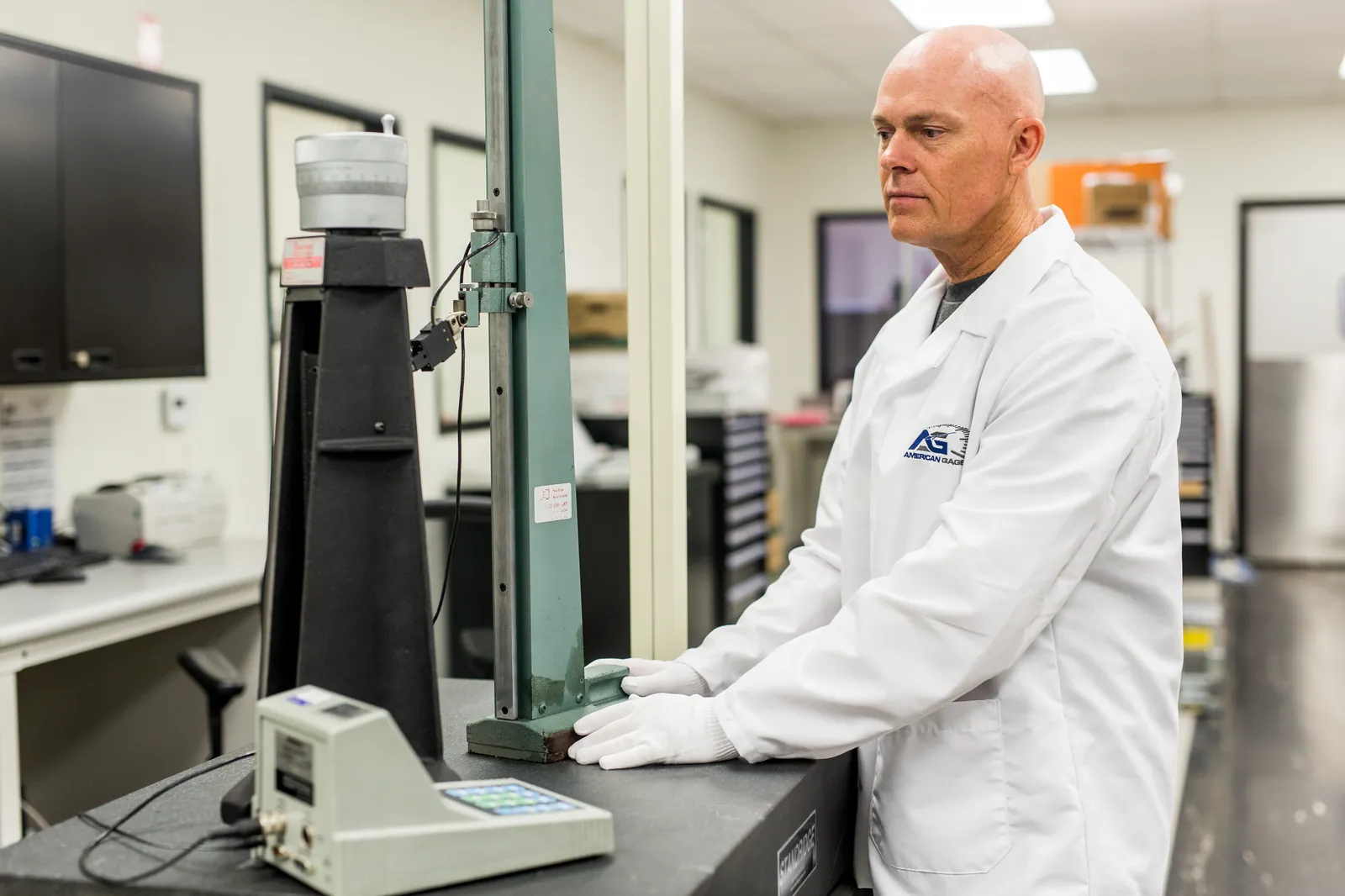
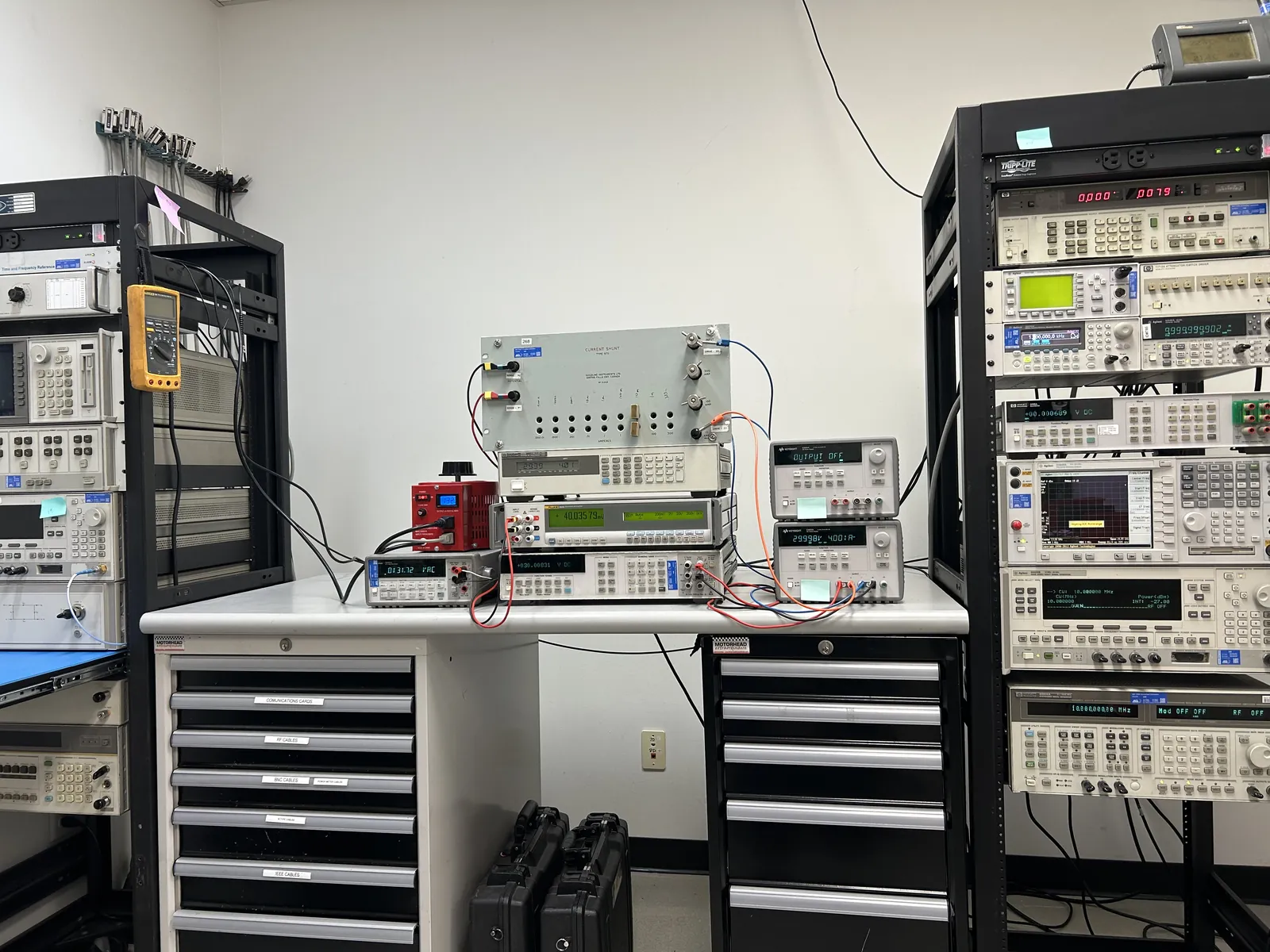
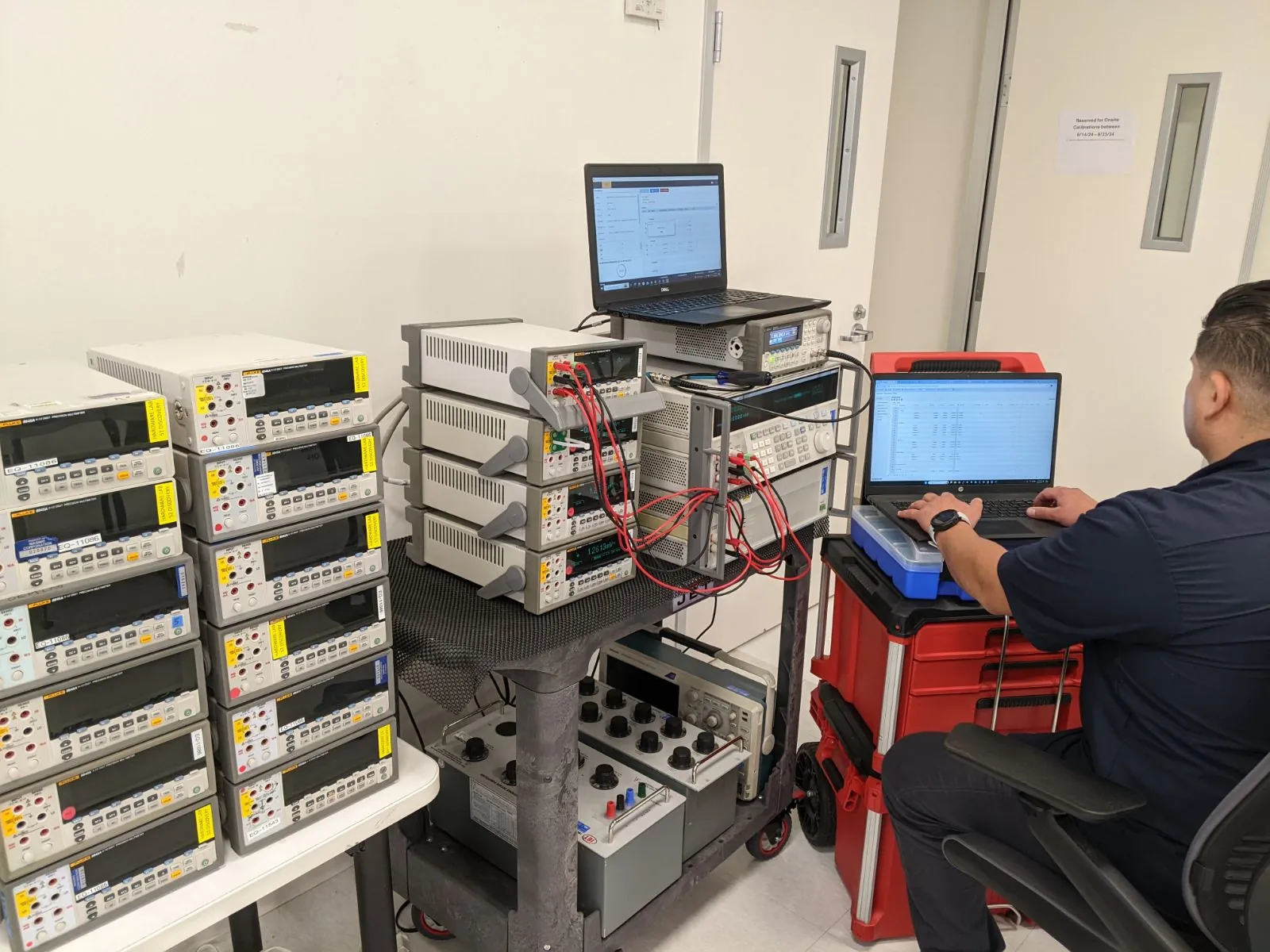
8,000 sq ft of discipline-specific, environmentally controlled laboratories in Placentia — accredited to ISO/IEC 17025:2017 by A2LA, certificate #4296.01. Nothing is forwarded to out-of-state labs.
Calibration capabilities available to Huntington Park companies
Huntington Park calibration FAQs
How far is your lab from Huntington Park?
About 26 miles — roughly 35 to 45 minutes to 1131 S Richfield Rd in Placentia, via SR-91 west and the I-5 north, then west on Slauson or Florence Avenue. No freeway enters Huntington Park, so the last mile or two is always on an arterial. The city is on our free Tuesday and Thursday Los Angeles County pickup route.
Can you support aerospace pyrometry requirements for heat treating?
Yes. Load and control thermocouples, system accuracy test instruments, temperature uniformity survey instrumentation, furnace controllers and recorders, over-temperature protection and cryogenic measurement — calibrated in our temperature laboratory with fixed-point traceability, and documented with as-found and as-left values, uncertainty and NIST traceability for Nadcap and AS9100 audit.
Do you calibrate NDT instrumentation?
Yes — densitometers, ultraviolet radiometers and visible-light meters for penetrant and magnetic particle booths, magnetic field meters and field indicators, eddy-current conductivity meters, hardness testers with certified blocks, and the multimeters and power supplies behind the equipment, all under our A2LA ISO/IEC 17025:2017 accreditation.
Can you calibrate plating and anodize line instruments?
Yes. Tank RTDs and thermocouples, bake oven thermocouples and uniformity surveys, rectifier verification, air pressure gauges and regulators, bath make-up balances and test weights, titration pipettes, coating thickness gages, and scrubber and ventilation flow measurement for air-district compliance.
Popular calibration services
- Pipette Calibration →
- Torque Wrench Calibration →
- Pressure Gauge Calibration →
- Caliper Calibration →
- Micrometer Calibration →
- Gage Block Calibration →
- Spectrum Analyzer Calibration →
- Network Analyzer Calibration →
- Signal Generator Calibration →
- Oscilloscope Calibration →
- On-Site RF Calibration →
- Torque Analyzer Calibration →
- Multimeter Calibration →
- Scale & Balance Calibration →
- Surface Plate Calibration & Resurfacing →
- Thread Gage Calibration →
- Force Gauge Calibration →
- Hardness Tester Calibration & Repair →
- Rush & Expedited Calibration →
- Mitutoyo Instrument Calibration →
- Starrett Instrument Calibration →
- Fluke Instrument Calibration →
Nearby service areas
Need calibration in Huntington Park?
Send your equipment list and we'll confirm scope, pricing, and turnaround within one to two business days — with free pickup on the Tuesday & Thursday route.