
Service Area · City
Calibration Services in Paso Robles
In Paso Robles, measurement accuracy is a federal tax matter. TTB gauging rules govern how a winery records volume and how a distillery determines proof, which makes hydrometers, thermometers and tank calibration certificates compliance documents rather than quality paperwork. On top of that the city has a medical silicone plant with ISO Class 7 and 8 cleanrooms, a certified tank fabricator, Firestone Walker’s main brewery and an airport industrial park with fifty businesses in it. We are about two hundred and thirty-five miles south, so this is a ship-in city with on-site visits by appointment.

Service model
Ship-in service, or on-site calibration by appointment
Inbound shipping
Outside our free pickup routes — inbound shipping or scheduled on-site
Turnaround
7–10 business days standard, expedited available
US-101, and a state route that is not continuous through town
The city’s legal name is El Paso de Robles, incorporated on 11 March 1889, and everyone calls it Paso. It sits on the Salinas River in the southern Salinas Valley against the eastern foothills of the Santa Lucia Range, roughly halfway between Los Angeles and San Francisco. US-101 is the only freeway and it bisects the city north to south alongside the river; the five-mile Paso Robles Bypass, completed in 1958, moved the highway off Spring Street onto a limited-access grade east of downtown, and Spring Street is now US-101 Business through town. The exits, north to south, are Spring Street at 232, SR-46 East and County Route G-14 Nacimiento Lake Drive at 231B, 16th Street at 231A, Pine Street at 230, the northbound business route at 229, and SR-46 West with Ramada Drive and Theatre Drive at 228.
SR-46 is not a continuous east-west road through Paso Robles. It exists as two legislative segments joined by a three-mile multiplex with US-101 between Exit 228 and Exit 231B. SR-46 West runs about twenty-two miles from SR-1 southeast of Cambria, east over the Santa Lucia Range through the Templeton Gap past a long run of wineries, and is designated the Eric Seastrand Memorial Highway. SR-46 East leaves the freeway at Exit 231B, crosses the Salinas River, runs east through wine country past Union Road and Whitley Gardens alongside the Estrella River through Shandon, merges with SR-41 at a rest area, splits from it again at the Cholame Wye, then crosses into Kern County over the Antelope Grade and down through Polonio Pass to the I-5 about two miles past Lost Hills and on to SR-99 at Famoso. The Paso Robles to Cholame stretch, historically nicknamed Blood Alley, was widened to a four-lane expressway from US-101 to just east of the SR-41 junction near Shandon as of 2016 and narrows further east. Two live projects on it: the SR-46 West interchange with US-101 is in planning for roundabouts, and the SR-46 East grade separation at Union Road was approved in October 2024 with construction estimated for 2026 and 2027.
Two state routes get credited to this city and neither enters it. SR-41 does not run through Paso Robles. It crosses US-101 in Atascadero and meets SR-46 at the Cholame Wye roughly twenty-five to thirty miles east, where a new interchange opened in June 2025. The confusion is historical and understandable — SR-41 did run on Spring Street multiplexed with US-101 from 1934 to 1964 — but that alignment is now SR-46 and US-101. SR-229 does not enter either, despite what some references say: it runs from SR-58 near Santa Margarita to SR-41 near Creston and is signed on Webster Road, so Creston Road out of Paso Robles is a city and county arterial rather than a state highway. No interstate serves San Luis Obispo County at all; the nearest I-5 access is about sixty-five miles east on SR-46, and SR-1 is roughly twenty-four miles west near Cambria. The industrial streets to know are Airport Road, Propeller Drive, Aerotech Center Way and Rollie Gates Drive in the airport park northeast of the freeway; Limestone Way, Ramada Drive, Cow Meadow Place, Theatre Drive and Union Road in the Tin City district south of downtown; and Commerce Way and Ardmore Road. The Union Pacific Coast Line runs through town, which is the reason the Union Road grade separation is being built, and Amtrak’s Coast Starlight stops here.
Why TTB gauging makes this a measurement town
The Paso Robles AVA was established on 4 October 1983 as the forty-fourth American viticultural area, on a petition from Martin Brothers Winery backed by fifty-one local growers and wineries. Its eleven sub-appellations were created by TTB final rule on 9 October 2014: Adelaida District, Creston District, El Pomar District, Paso Robles Estrella District, Paso Robles Geneseo District, Paso Robles Highlands District, Paso Robles Willow Creek District, San Juan Creek, San Miguel District, Santa Margarita Ranch and Templeton Gap District. About forty thousand acres are planted across more than two hundred wineries, with Zinfandel as the heritage variety alongside Cabernet Sauvignon and Rhône styles. The mechanism behind the appellation is the Templeton Gap, which funnels marine air inland and produces the diurnal temperature swing the region is known for.
Several producers here operate at genuine commercial scale, and the ownership facts have changed recently enough to be worth stating. J. Lohr Vineyards & Wines is at 6169 Airport Road with its Paso Robles Wine Center, open since 2001, and farms more than twenty-five hundred acres of estate vineyards across five Paso Robles sub-appellations, with corporate offices in San Jose. JUSTIN Vineyards & Winery is at 11680 Chimney Rock Road, making Bordeaux-style reds with barrel aging in small French oak, wine caves and an in-house grape-quality air-knife process. Robert Hall Winery at 3443 Mill Road was acquired by O’Neill Vintners & Distillers in 2016 from the Hall family and farms Regenerative Organic Certified estate vineyards — it is not family-owned. DAOU Family Estates is owned by Treasury Wine Estates, which announced the acquisition in October 2023 covering three wineries and three hundred and eighty-nine acres of Paso Robles vineyards. And Hope Family Wines, behind Austin Hope, Treana, Quest, Liberty School and Troublemaker, opened a hundred-and-forty-thousand-square-foot warehouse with a million-case capacity in January 2025, with an adjacent bottling line running two hundred bottles a minute with high-speed optical inspection and automated pallet stacking.
Winery instrumentation is its own discipline and it runs deep. Brix refractometers, bench and handheld, with hydrometers and digital density meters. pH meters against certified buffers, conductivity meters, and autotitrators for titratable acidity and for free and total sulphur dioxide by aeration-oxidation and Ripper methods. Temperature probes, thermocouples, RTDs and data loggers on fermentation tanks, jacketed-tank glycol loops, barrel rooms, caves and cold stabilization. Pressure gauges on presses, must and wine pumps, crossflow and plate-and-frame filters and nitrogen or carbon dioxide blanketing lines, with vacuum gauges on fillers and corkers. Dissolved oxygen and dissolved carbon dioxide meters. Tank volume certification on stainless fermenters and storage tanks, and bottling-line fill-height and net-content verification, which is the TTB-driven work. Analytical and top-loading balances with mass standards, pipettes and spectrophotometers in the lab. Flow meters on must, wine transfer, glycol and process water. Torque gauges for screwcap application torque and closure extraction force. Gondola, crush-pad, forklift and truck scales. And humidity sensors in the barrel rooms and caves. The governing rules are 27 CFR Part 24 for wine, Part 4 for labeling, and Part 30 — the TTB Gauging Manual — which is why volumetric accuracy here is a federal tax matter rather than a quality nicety. One headwind belongs alongside all of that, because it shapes what a quality manager can spend. San Luis Obispo County wine grape revenue fell roughly forty percent in 2024, and in the 2025 crop report wine grapes finished second in the county at $196.1 million behind strawberries at $310.6 million. Capital spending in the local wine sector is tight. Worth attributing correctly too: the county’s strawberry crop is grown mainly in the Santa Maria and Nipomo area of south county, not around Paso Robles. Wine grapes, cattle and calves, grain, orchards and olives are the Paso Robles agriculture.
Firestone Walker, the distillery trail, and Tin City
Firestone Walker Brewing Company’s main production brewery is at 1400 Ramada Drive, founded in 1996 and now part of Duvel Moortgat USA. We publish no barrelage figure for it, because no current one is on the record. RE:FIND Distillery at 2725 Adelaida Road distils vodka and gin from free-run juice from Paso Robles wine grapes and makes a grain whiskey in collaboration with Firestone Walker that is aged on site; it is co-owned with Villicana Winery. The Paso Robles Distillery Trail had thirteen stops as of March 2024, including RE:FIND, Pendray’s, KROBĀR Craft, Bethel Rd. Distillery, Calwise Spirits Co. and Rod & Hammer’s.
Tin City is the single best piece of industrial geography in the city and the reason a calibration route here is efficient. It is a walkable production district just south of downtown off Exit 228, centred on Limestone Way, with the Tin City Annex along Ramada Drive and Cow Meadow Place. Inside it: Field Recordings, Turtle Rock Vineyard, Desparada Wines, Aaron Wines, Tin City Cider Co., Sans Liege, BENOM, Nicora, ONX Wines, Hubba Wines, End Of The Day, Giornata, Etto Pastificio making pasta, Olivas de Oro Olive Company pressing olive oil, Negranti Creamery working in sheep’s milk, and Six Test Kitchen. The Annex holds Anarchy Wine Co., Cordant and Nelle, Anglim Winery, Seven Oxen Estate Wines, Calwise Spirits, MCV, Cloak & Dagger Wines and Emercy Wines. Two dozen small producers inside a few blocks is a materially different proposition from two dozen scattered across a county.
A distillery’s instrument list is shorter than a winery’s and the stakes on it are higher, because 27 CFR Part 19 makes proof determination and gauging a regulated act. TTB proofing hydrometers and precision thermometers for proof gauging, tank calibration certificates for spirits tanks, and volume records that have to reconcile. For the brewery, 27 CFR Part 25: hydrometers and density meters and refractometers for original and final gravity, mash and kettle and fermenter temperature probes and recorders, steam pressure gauges and relief valves, carbon dioxide and dissolved oxygen meters, carbonation testers, pH and turbidity meters, flow meters on wort, beer, water and glycol, torque on crowners, cappers and seamers, keg and can seam pressure gauges, fill-level and net-content checks with checkweighers, and lab balances and pipettes with autoclave temperature and pressure verification. On the food side of Tin City, FDA preventive controls at 21 CFR Part 117 apply fully to Etto Pastificio, Negranti Creamery and Olivas de Oro. Wineries, breweries and distilleries are FDA-registered food facilities but most qualify for modified requirements as alcohol-related facilities under 21 CFR 117.5(i), which is a distinction worth drawing precisely.
Cleanrooms on Rollie Gates Drive, and tanks built to AWWA
The highest-rigor account in Paso Robles is Specialty Silicone Fabricators at 3077 Rollie Gates Drive, now part of the Trelleborg group after a 2016 acquisition and sitting under Trelleborg Healthcare & Medical — it is not an independent company. It makes silicone components for medical devices by extrusion, molding, calendering, sheeting, dipping, micromolding and coating, and does device assembly, final package design and validation and high-tolerance thermoplastic extrusions; it works with active pharmaceutical ingredients and has been federally registered and state licensed for that since 2009. The facility inaugurated in May 2012 contains thirty-five hundred square feet of ISO Class 7 cleanroom and thirty-five thousand square feet of ISO Class 8.
That combination — tight dimensional tolerances, validated cycles and classified space — touches most of our disciplines at once. Micrometers, calipers, pin and bore gauges, optical comparators, vision systems and coordinate measuring machines for extrusion inside diameter, outside diameter and wall thickness and for molded dimensions. Tensile and elongation testers, durometers and force gauges for pull, peel and burst testing. Injection and compression press pressure transducers, temperature controllers and thermocouples for mold and barrel temperature, and cavity pressure. Cleanroom monitoring to ISO 14644: differential pressure gauges, particle counters, air velocity instruments and flow hoods, and temperature and relative humidity sensors. Sterilizer temperature and pressure mapping and oven cure-cycle temperature uniformity surveys. Analytical balances and microbalances, pipettes, and conductivity and total organic carbon meters on the water systems. And torque wrenches and pressure-decay leak testers on assembly. The governing regimes are FDA’s quality system requirements at 21 CFR Part 820, now transitioning to the Quality Management System Regulation, together with ISO 13485:2016, ISO 14644 for the cleanrooms and the ISO 11135 and 11137 sterilization validation standards where they apply.
Paso Robles Tank, a wholly owned subsidiary of Associated Construction and Engineering, is the other serious manufacturer. It engineers, fabricates, erects, repairs, maintains and coats carbon and stainless steel aboveground storage tanks and specialty vessels — including stainless steel wine tanks and AWWA D103 bolted steel tanks through a bolted tank division launched in 2016 — out of a thirty-six-thousand-square-foot Paso Robles facility, with further plants in Hemet and in Sparks, Nevada. It holds SSPC QP1, QP2 and QP3 certifications and its staff include AWS Certified Welding Inspectors, NACE Certified Coatings Inspectors and NCCCO Certified Crane Operators, which means its instrument list is partly a coating-inspection list that most calibration vendors never see: ultrasonic thickness gauges, dry film thickness gauges, holiday detectors, surface profile gauges, dew point meters and hygrometers, alongside hydrostatic test gauges and deadweight testers for tank hydro and pneumatic testing, welding machine amperage and voltage meters, rod oven temperature controls, hardness testers and weld inspection gauges, and crane and rigging load cells and proof-test weights for tank erection. A company that builds stainless wine tanks for this valley and also certifies their volume is a natural adjacency for a lab that calibrates the gauges on both sides of that transaction.
The airport, the spaceport application, and what we will not claim
Paso Robles Municipal Airport is city-owned, covers roughly thirteen hundred acres four to five miles northeast of downtown off SR-46 East, and runs two asphalt runways: 01/19 at 6,008 by 150 feet and 13/31 at 4,701 by 100 feet, plus a helipad. The FAA counted a hundred and fifty-seven based aircraft in 2022. Its named tenants and operators include ACI Jet as the fixed-base operator, Air Jav, Flight Environments, Genuine Aircraft Hardware Co., Del Rio Aviation, a CAL FIRE Air Attack Base running fire retardant operations, California Highway Patrol Air Operations and a Civil Air Patrol squadron. Around it the Airport Road Industrial Park holds roughly five hundred thousand square feet of building space and nearly fifty businesses, aviation maintenance providers and parts manufacturers among them, part of it zoned by the city as its Technology Corridor. Aviation work puts torque wrenches and multipliers at the centre of the list, because AC 43.13 and OEM values are the standard, alongside micrometers, calipers, bore gauges, gage blocks, granite surface plates, cable tensiometers, tachometers, pitot-static testers, altimeter and transponder test sets, multimeters and fuel-quantity test sets.
There is a genuine aerospace test story here and it is easy to overstate, so here is the careful version. Stellar Explorations, a San Luis Obispo small-spacecraft propulsion firm, tests its hardware at a renovated test site at the Paso Robles airport, built from recycled road material off city street repairs on a rebuilt wartime access road; it has worked with NASA, including the CAPSTONE project, with the Department of Defense and with commercial contractors. Separately, the city is pursuing an FAA commercial spaceport licence for horizontal launch. As of July 2026 the city expected to bring a consultant contract to Council in September 2026, with final technical, environmental and safety studies beginning around October, and hoped to complete the application and obtain a licence in early 2028. A spaceport licence would permit horizontal launches only, and each aerospace company would still need its own FAA launch licence. Dawn Aerospace has been in discussions, and Cal Poly San Luis Obispo, Cuesta College and local career-technical programmes are named workforce partners. Paso Robles is not a licensed spaceport today.
We name no AS9100, Nadcap or 14 CFR Part 145 certificate holder here, because none is on the record — those standards describe the kind of work the airport park does rather than certifications we can attribute to a named company. There is no port, no defense-industrial base, no biotech or semiconductor presence and no food-processing centre. There is no hospital in the city: the area hospital is Adventist Health Twin Cities at 1100 Las Tablas Road in Templeton, a hundred and twenty-two licensed beds, about seven road miles south on US-101, and it was renamed when Adventist Health completed its acquisition from Tenet in April 2024, so Twin Cities Community Hospital, a Tenet facility, is two years out of date as a name. There is no commercial airline service; the nearest is San Luis Obispo County Regional Airport about twenty-five miles south. We publish no headcounts for any Paso Robles employer, and in particular not the seventeen-hundred figure that circulates for a local themed-props manufacturer, which was a 2020 and 2021 personal protective equipment production peak rather than a current number. One piece of local history explains the building stock: the magnitude 6.6 San Simeon earthquake on 22 December 2003, centred about twenty-five miles northwest, collapsed the roof of the downtown clock tower building and killed two people, and reactivated dormant underground springs that flooded the City Hall and library parking lot and opened a sinkhole not resurfaced until December 2010. A new clock tower stands as a memorial. What genuinely applies here is TTB Parts 24, 19, 25, 4, 5 and the Part 30 Gauging Manual, FDA preventive controls at 21 CFR Part 117 with the 117.5(i) modified requirements for alcohol-related facilities and the Produce Safety Rule at Part 112 on the farming side, FDA 21 CFR Part 820 transitioning to the QMSR with ISO 13485:2016 and ISO 14644 at the silicone plant, SSPC and NACE coating-inspection practice with AWS welding qualification at the tank works, California Division of Measurement Standards with San Luis Obispo County weights and measures registration and its weighmaster and net-contents programmes, San Luis Obispo County Air Pollution Control District authority to construct and permit to operate requirements, DOT and FMCSA on the distribution fleets, and NIST traceability under all of it. Paso Robles is outside our free pickup footprint, so the model is ship-in with prepaid inbound freight or on-site calibration by appointment — hydrometers, thermometers, refractometers, pH and titration instruments, pipettes, balances, torque tools, gauges and coating-inspection instruments all ship well, while tank volume certification, in-place pressure and flow instrumentation, platform and truck scales and large chambers are the on-site work. All nine disciplines run under one roof: dimensional, electrical and RF, temperature and humidity, pressure, mass, pipettes, force and torque, gas flow and vibration. American Gage has calibrated from inside Orange County since 1968, under current ownership since 1998, with more than a million calibrations performed in an 8,000 sq ft facility. Every certificate carries as-found and as-left data, measurement uncertainty, NIST traceability and the ANSI/NCSL Z540.3 decision rule with TUR, under ISO/IEC 17025:2017 accreditation from A2LA, certificate 4296.01. Standard turnaround is 7–10 business days with expedited 24, 48 and 72-hour options.
Industries we serve in Paso Robles
- Wine Production
- Brewing & Distilling
- Medical Device Components
- Tank Fabrication & Coatings
- Aviation & Aerospace Test
The Lab Behind the Routes
Where Paso Robles instruments actually get calibrated.
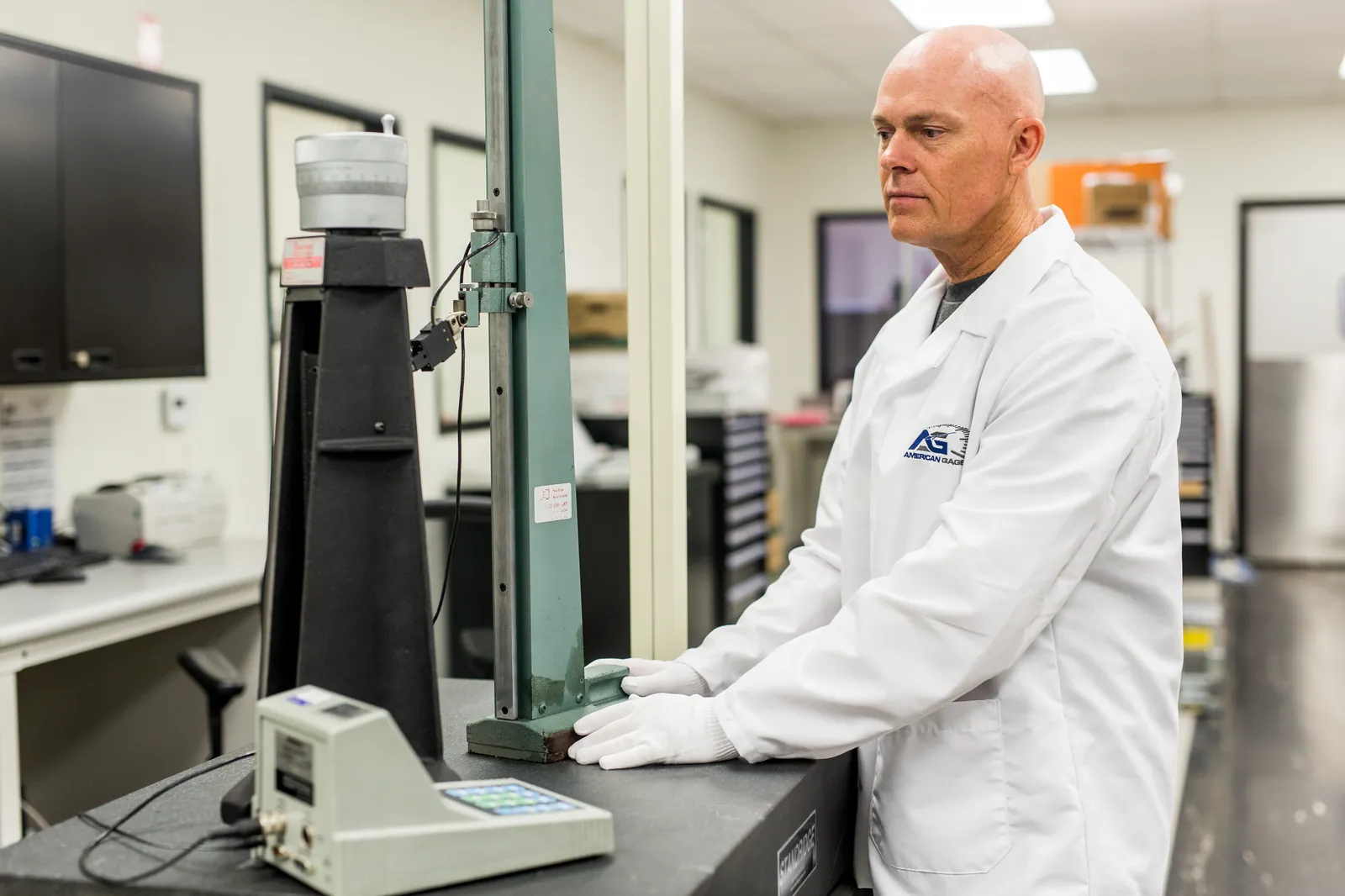
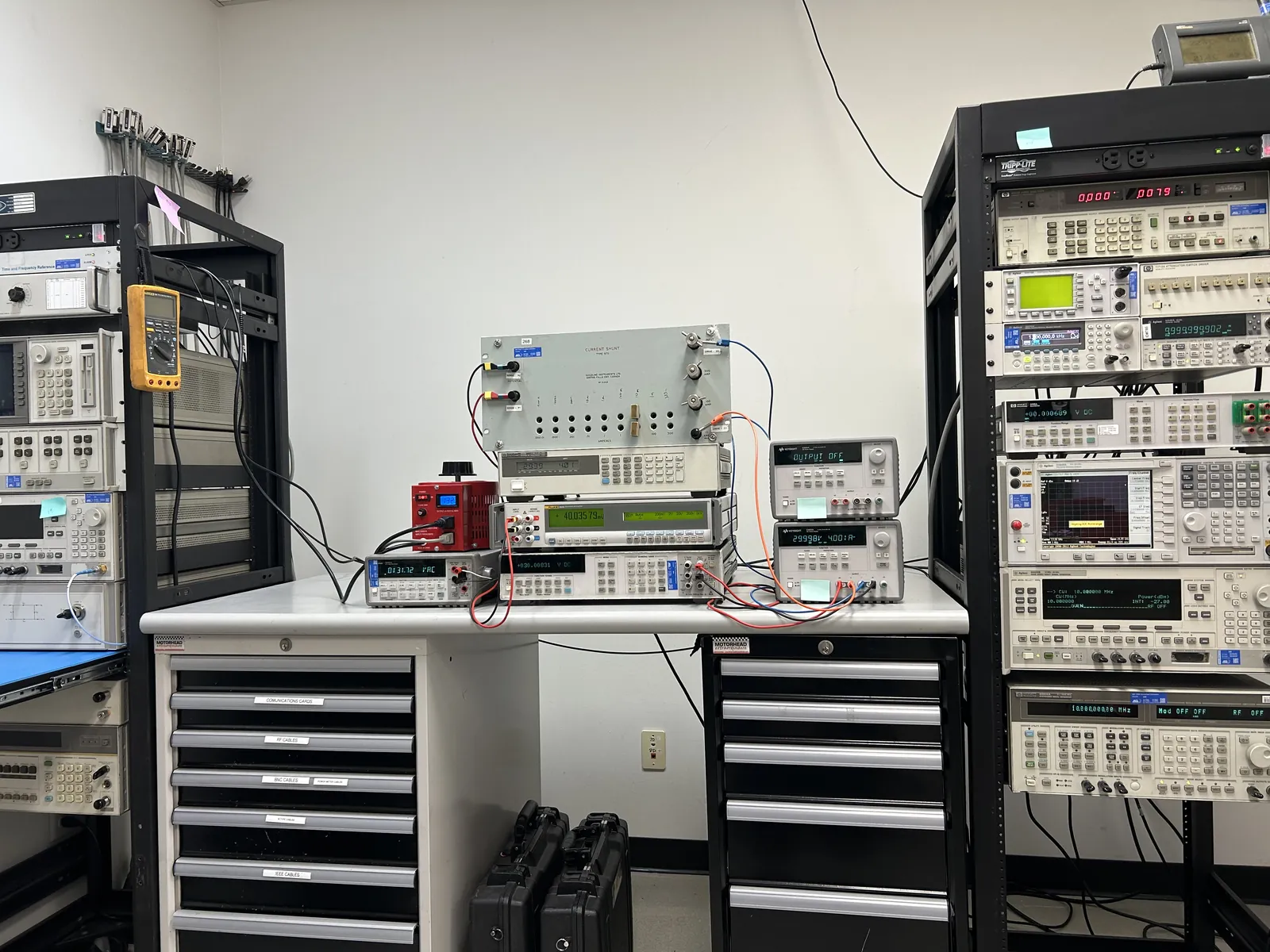
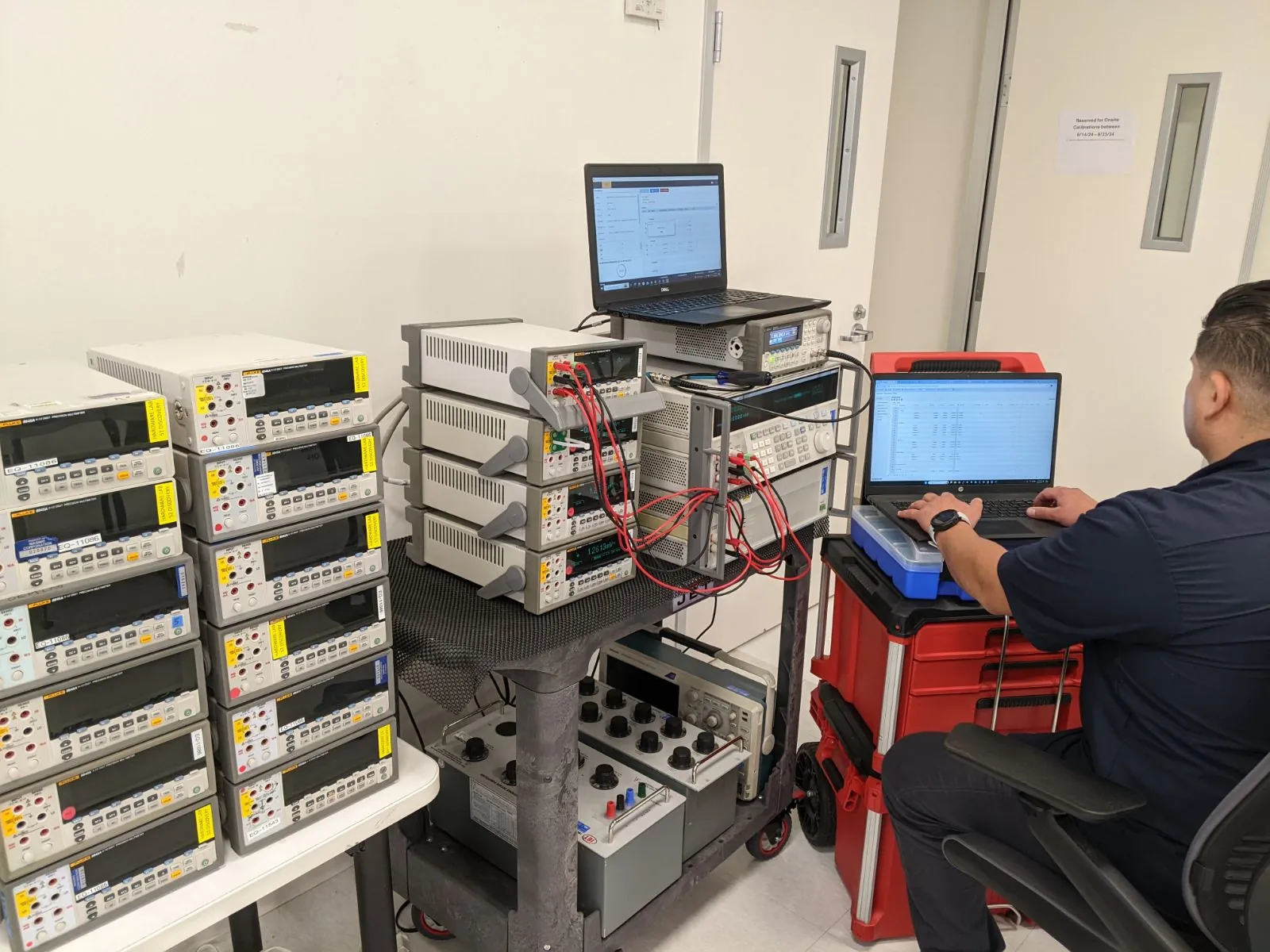
8,000 sq ft of discipline-specific, environmentally controlled laboratories in Placentia — accredited to ISO/IEC 17025:2017 by A2LA, certificate #4296.01. Every instrument you ship is calibrated here and returned to you — never sub-contracted to another lab.
Calibration capabilities available to Paso Robles companies
Paso Robles calibration FAQs
Paso Robles is not on your pickup routes. How does the work get done?
By freight, mostly, with on-site visits by appointment for what cannot travel. Hydrometers, proofing hydrometers, precision thermometers, refractometers, pH and titration instruments, pipettes, balances and weights, torque tools, pressure gauges and coating-inspection instruments all ship safely, and we can arrange prepaid inbound shipping. Tank volume certification, in-place pressure and flow instrumentation, platform and truck scales and large chambers we schedule on site. Standard turnaround is 7 to 10 business days with expedited options.
Do you calibrate the hydrometers and thermometers TTB gauging depends on?
Yes, and it is work we treat as compliance rather than housekeeping. TTB proofing hydrometers and precision thermometers for proof gauging under 27 CFR Part 19, density meters and refractometers, and the volume side under Part 24 and the Part 30 Gauging Manual. Every certificate carries as-found and as-left data, measurement uncertainty and NIST traceability, which is what a TTB record needs standing behind it.
Can you support a medical device cleanroom operation at this distance?
Yes. Dimensional metrology for extrusion ID, OD and wall and for molded parts, tensile and elongation testers, durometers and force gauges, press pressure transducers and mold thermocouples, cleanroom differential pressure, particle counting, air velocity and flow hood verification to ISO 14644, sterilizer and oven temperature mapping and uniformity surveys, analytical balances and microbalances, and pipettes. Most of it ships; the cleanroom and chamber work is on site by appointment.
Is there a hospital in Paso Robles?
No. The area hospital is Adventist Health Twin Cities at 1100 Las Tablas Road in Templeton, about seven road miles south on US-101, with a hundred and twenty-two licensed beds. It was Twin Cities Community Hospital under Tenet until Adventist Health completed the acquisition in April 2024. We calibrate hospital biomedical and clinical laboratory instruments — pipettes, balances, centrifuge tachometers, certified thermometers and data loggers, autoclave verification and medical-gas gauges — at either location by arrangement.
Popular calibration services
- Pipette Calibration →
- Torque Wrench Calibration →
- Pressure Gauge Calibration →
- Caliper Calibration →
- Micrometer Calibration →
- Gage Block Calibration →
- Spectrum Analyzer Calibration →
- Network Analyzer Calibration →
- Signal Generator Calibration →
- Oscilloscope Calibration →
- On-Site RF Calibration →
- Torque Analyzer Calibration →
- Multimeter Calibration →
- Scale & Balance Calibration →
- Surface Plate Calibration & Resurfacing →
- Thread Gage Calibration →
- Force Gauge Calibration →
- Hardness Tester Calibration & Repair →
- Rush & Expedited Calibration →
- Mitutoyo Instrument Calibration →
- Starrett Instrument Calibration →
- Fluke Instrument Calibration →
Nearby service areas
Need calibration in Paso Robles?
Send your equipment list and we'll confirm scope, pricing, and turnaround within one to two business days — then ship your instruments to our Placentia lab for accredited calibration and return.